Bollito Misto and Carrù's Bue Grasso: What to Pour This December
Carrù's 116th ox fair is on 17 December. How Piemonte's great boiled-meat feast is built, and the wines estates suggest with it.
Il Vino Bello ·
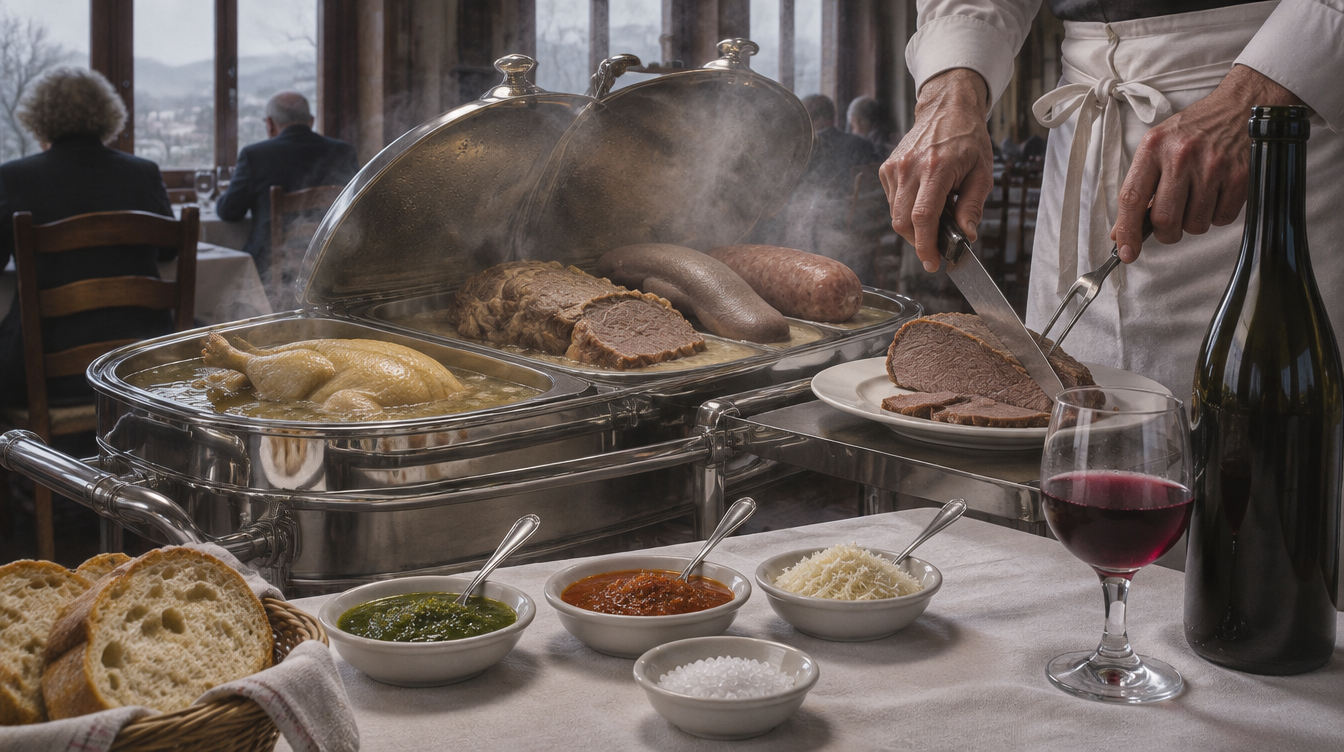
On Thursday 17 December, the foro boario in Piazza Mercato in Carrù fills with white Piemontese oxen for the 116th Fiera del Bue Grasso. It is a cattle show, a market day and, for everyone who comes to watch, an excuse to sit down to the dish this village is known for: bollito misto. Here is the fair, the dish, and what Piemonte estates suggest pouring with it.
A fair with five centuries behind it
The organisers trace cattle markets in Carrù back to a decree of 7 April 1473, signed by Yolande of France as regent for the young Duke Filiberto I, which allowed twice-weekly markets "in opulento loco Carruci". A ducal decree of 1635 added a three-day annual fair after the feast of San Carlo. The fair in its current form began on 15 December 1910, set up by the town council to tackle a shortage of animals for slaughter and rising meat prices. The first edition drew 2,100 cattle, 200 pigs, 500 sheep and about a thousand head of poultry, and the fair has stopped only once since, in the winter of 1944.
The star is the bue grasso itself. According to the fair's own description, it is a white Piemontese animal castrated within eight months of age, fattened slowly on hay, maize, bran, soy, broad beans and barley, and called a bue only after its fourth year. The largest can pass 1,400 kilograms. They are judged in three classes (Nostrano, della coscia or Fassone, and Migliorato), and the winner of each category takes home the gualdrappa, a hand-made cloth with an ox's head on a white ground, awarded since 1910.
The rule of seven
The fair's page on the ox at table calls Bollito Misto alla Piemontese its best-known use and describes it by the "regola del sette": seven cuts of beef (scaramella, punta di petto, brutto e buono, muscolo, stinco, cappello del prete and reale con osso), seven "ornamenti" cooked separately (calf's head with its muzzle, tongue, trotter, tail, hen, cotechino and rolata, which some replace with lonza), and a set of sauces. The fair names bagnetto verde of parsley, anchovies, garlic, vinegar and stale breadcrumb, bagnetto rosso of tomato, red pepper, garlic, mustard and red vinegar, horseradish sauce, the honey, walnut and mustard salsa delle api, and mostarda d'uva.
Not every kitchen agrees on the list. Gazzetta del Gusto, following the version reconstructed by the Accademia Italiana della Cucina, gives a different seven cuts, seven sauces and seven side vegetables. It also has the wine advice that matters here: before the meat arrives, a few pieces of cacciatorino salami "per far la bocca al primo Barbera, preferibilmente giovane" (to get the mouth ready for the first Barbera, preferably young; our translation).
The everyday pour: young Barbera, Dolcetto and a little fizz
Many producers on our site name bollito on their own wine pages, and for an ordinary lunch most of them point to young, fresh reds:
- Cascina Castlèt calls its simplest Barbera d'Asti, nicknamed Vespa, "an everyday, all-meal wine", mixed boiled meats included.
- Terre dei Santi in Castelnuovo Don Bosco suggests its young Barbera d'Asti, matured in concrete and meant for drinking within one to three years, for "risotto with Barbera, meat agnolotti, bollito misto".
- Fratelli Aresca in Mombercelli names bollito misto first for its Venere, a Dolcetto di Ovada aged in steel.
- Cantina Clavesana pairs its Dogliani Mito, a Dolcetto from the Dogliani DOCG, with first courses in traditional meat sauce and with bollito.
- For the cotechino, Boveri Luigi in the Colli Tortonesi offers Casassa, a lightly sparkling Bonarda with two months in steel, recommended for "cotechino and mixed boiled meats".
When the bollito is the main event
For a long Sunday lunch with the whole trolley, the estates point to wines with more weight, several of them among this year's award winners.
La Bogliona, the Barbera d'Asti Superiore of Antica Casa Vinicola Scarpa in Nizza Monferrato, spends 32 months in large French oak. The 2021 holds Tre Bicchieri in Gambero Rosso's Vini d'Italia 2027 and 5 Grappoli from Bibenda, and the estate lists "Piedmontese mixed boiled meats" and "veal tongue carpaccio with green sauce" among its matches. From the Monferrato Casalese, Vicara's Cantico della Crosia, Tre Bicchieri 2027 for the 2022, is suggested by the estate with fried boiled-meat polpette, among other dishes. Fratelli Aresca's La Rossa, a Barbera d'Asti Superiore whose 2023 is in AIS Vitae's 100 Vini Valore, is another the estate pairs with mixed boiled meats.
Nebbiolo has its place too. Marchesi di Barolo lists boiled meats for both its Cannubi (2022: Bibenda 5 Grappoli and a Faccino in the Guida Essenziale ai Vini d'Italia) and its Sarmassa (2022: Tre Stelle Oro from Veronelli). Garesio in Serralunga puts "mixed boiled meats" first for its organic Barolo Gianetto. And for something off the usual path, Cantina Roggero in Albugnano suggests bollito with Dionisiaco, a Freisa d'Asti Superiore aged a year in tonneau and barrique.
Going to Carrù
The fair day itself is Thursday 17 December, with the cattle judged at the foro boario and the usual weekly market running alongside. The organisers' programme starts weeks earlier: a Gran galà del bollito lunch at 13.00 on Sunday 29 November, Sunday 6 December and Tuesday 8 December (booked by phone), a breakfast of the Confraternita del gran bollito e del bue grasso at 9.00 on 6 December, and talks, music and a show cooking of traditional products through to 20 December.
That breakfast has a story. In 2019 Cuneodice described the "colazione del contadino" of tripe, bollito and red wine served in Carrù's bars and osterie from 5.30 on fair morning, a habit of breeders who once walked through the night to reach the market, revived by a group of locals in the early 1990s.
For the other great Piemonte winter table, see our guide to Bagna Cauda Day 2026, and for the cheese course, Piemonte Cheese and Wine.
Sources
- https://www.fieradelbuegrassodicarru.it/
- https://www.fieradelbuegrassodicarru.it/programma
- https://www.fieradelbuegrassodicarru.it/la-storia-della-fiera
- https://www.fieradelbuegrassodicarru.it/che-cos-e-il-bue-grasso
- https://www.fieradelbuegrassodicarru.it/il-bue-grasso-a-tavola
- https://www.fieradelbuegrassodicarru.it/news/100/LA-RASSEGNA-ZOOTECNICA
- https://gazzettadelgusto.it/cibo/bollito-misto-piemontese-storia-e-ricetta/ (updated 22 May 2024)
- https://cuneodice.it/curiosita/fossanese/a-carru-la-colazione-si-fa-alle-5-e-mezza-del-mattino-con-trippe-bollito-e-vino-rosso_31578.html (2 Dec 2019)