Gavi Explained: Cortese, Eleven Comuni and What the Label Tells You
Piemonte's great export white, from Genoese villas to "del comune di" labels, Riserva rules and the consorzio's view of 2026.
Il Vino Bello ·
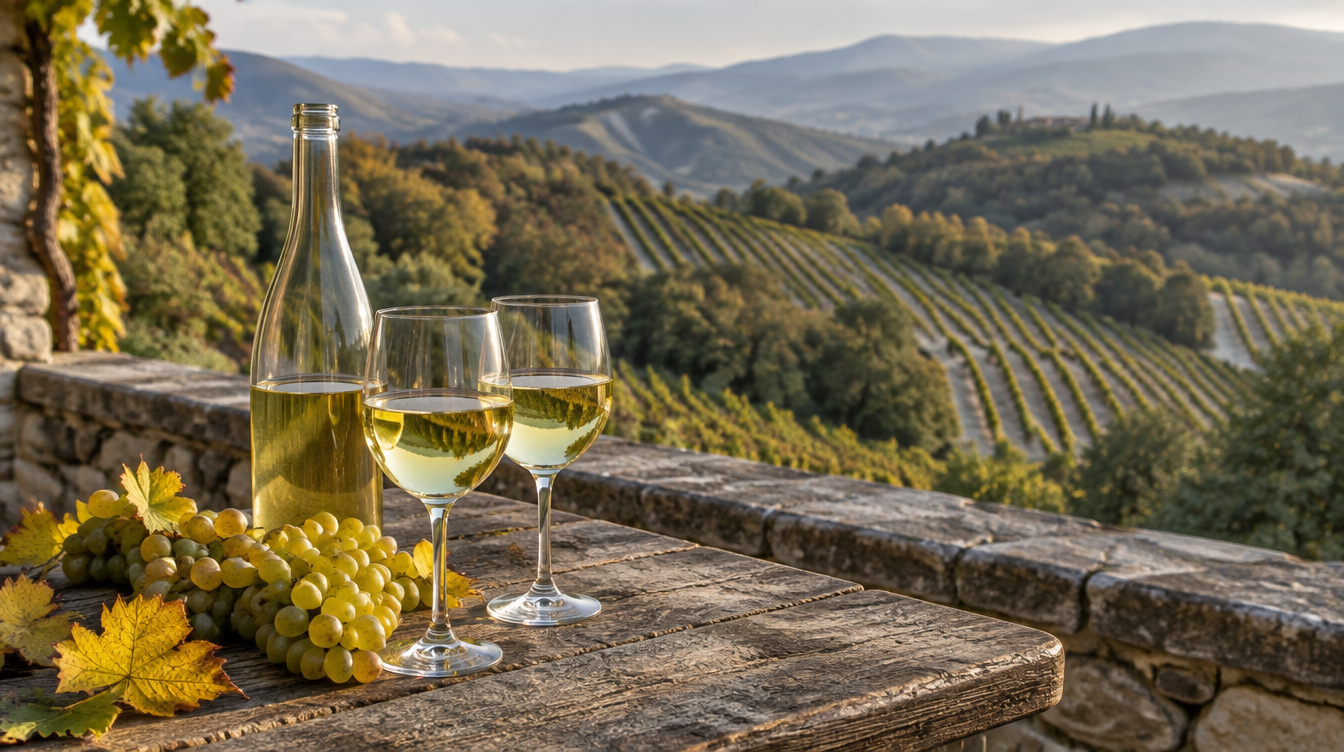
Piemonte is red wine country, yet one of its best-travelled bottles is white. Gavi, made only from Cortese in the hills where Piemonte meets Liguria, closed 2025 with about 14 million bottles sold, and more than 12 million of them went abroad, according to its consorzio. The consorzio has just posted its technical note on the 2026 season, a good moment to look at what the name on a label promises.
A white wine with a Genoese accent
The Gavi hills belonged to Genoa for centuries. The consorzio tells how the Forte di Gavi, guarding the main road between the plain and the sea, was joined in the 17th century by the summer villas of Genoa's great families, from the Giustiniani to the Lomellini, and how that aristocracy adopted Cortese as its court grape.
The paper trail is long. The production rules cite a document in the State Archive of Genoa dated 3 June 972, in which the bishop of Genoa leases vineyards at Meirana to two men from Gavi. The name lives on: Broglia bottles its emblematic Gavi as La Meirana, after the estate first recorded in that year. The rules also cite vineyards of "viti tutte di cortese" (vines all of Cortese) in 1659.
Modern Gavi starts in 1856, when the Marquis Cambiaso planted some of the first specialised Cortese vineyards at La Centuriona and La Toledana, according to the consorzio. "In a few decades," it adds, "Gavi became synonymous with dry white wine" (our translation). The DOC followed in 1974 and the DOCG in 1998.
Eleven comuni, three kinds of soil
The zone covers all or part of 11 comuni in the province of Alessandria: Bosio, Capriata d'Orba, Carrosio, Francavilla Bisio, Gavi, Novi Ligure, Parodi Ligure, Pasturana, San Cristoforo, Serravalle Scrivia and Tassarolo. Only hillside vineyards qualify, and damp valley floors are excluded; the rules describe vines growing between 150 and 450 metres.
The consorzio divides the geology into three bands. To the north, towards Tassarolo and Novi Ligure, are the terre rosse, red soils formed from old alluvial gravels mixed with clay, on gentler hills. A central band from Serravalle Scrivia through Gavi to San Cristoforo alternates marl and sandstone. The steeper south, towards the Apennines, is white clay marl full of marine fossils.
You can taste your way across that map with wines on the site. La Mesma's Riserva Vigna della Rovere Verde comes from an old vineyard on red soil at 300 metres in Tassarolo. Roberto Ghio's Riserva Le Zucche grows at 350 to 400 metres in Bosio on white calcareous marl the estate calls "Dentin". In Tassarolo, La Zerba makes Terrarossa from 30-year-old organic vines, with partial cold maceration on the skins.
How to read a Gavi label
Every Gavi, whether labelled "Gavi" or "Cortese di Gavi", is 100% Cortese. The rules allow five types: still, frizzante, spumante, Riserva and Riserva Spumante metodo classico. Still Gavi must show its vintage.
"Del comune di". Still, frizzante and spumante wines may add the name of the comune the grapes come from, written as "del comune di" under the DOCG line, and sometimes a hamlet too. The rules list Rovereto, Monterotondo and Pratolungo in Gavi, Costa Santo Stefano and Capanne di Marcarolo in Bosio, and Cadepiaggio and Tramontana in Parodi Ligure. Castello di Tassarolo's biodynamic Spinola is a Gavi del Comune di Tassarolo, made without added sulphur dioxide, the estate says. La Mesma's Etichetta Nera comes from a south-facing vineyard at Monterotondo, and Nicola Bergaglio's Rovereto from the iron-rich red clay around that hamlet.
Riserva. A Riserva may not name a comune but must name its vineyard, with "vigna" followed by the place name. Its yield is capped at 6.5 tonnes of grapes per hectare, against 9.5 for the standard wine, and it ages for a year, six months of it in bottle, before release from 1 November of the year after the harvest. La Raia's Vigna Madonnina Riserva, from vines about forty years old, spends six months in steel and at least six in bottle.
Bubbles. The Riserva Spumante metodo classico needs two years of ageing, 18 months of it on the lees in bottle, and must state the disgorgement date and vintage. Producers can wait far longer: La Ghibellina's metodo classico Cuvée Marina rests at least 48 months on the lees, the estate says.
The 2026 vintage, as the consorzio sees it
The consorzio's technical note calls 2026 "una stagione intensamente calda", an intensely hot season. After a winter with good rainfall and a mild February and March, budbreak came from mid-April and the first flowers around 20 May, about seven days ahead of 2025. From mid-June temperatures settled around 35°C and held almost unchanged until 20 August; a few showers near harvest eased the vines.
Picking began in the earliest sites in the last week of August and spread across the zone in the first week of September. Good water reserves in the soil and the resilience of Cortese brought in grapes with good sugar, good yields and modest acidity. The consorzio rates the vintage 4.7 stars, scoring health 100 out of 100 and acidity 85.
Drinking and visiting
The United Kingdom took 7 million bottles in 2025, more than 60% of exports, WineNews reported from the consorzio's figures, and Italian sales have just climbed back above a million bottles after a decade of decline. Consorzio president Maurizio Montobbio linked the home market partly to wine tourism: "the winery is becoming a place of discovery and connection", as WineNews quoted him in English.
If you go, book ahead. La Mesma runs guided tastings booked online at its cellar between Novi Ligure and Tassarolo, La Zerba takes visitors by reservation only with groups of up to 12, and Broglia hosts guided tastings at the La Meirana estate, booked in advance.
Sources
- https://www.consorziogavi.com/wp-content/uploads/stagione-2026.pdf (consorzio technical note on the 2026 season, updated 6 October 2026)
- https://www.consorziogavi.com/gavi-docg/
- https://www.consorziogavi.com/il-gavi-docg-consolida-la-presenza-internazionale/ (1 July 2026)
- https://winenews.it/en/gavi-docg-consolidates-itself-abroad-and-grows-in-italy-wine-tourism-as-growth-driver_597228/ (29 June 2026)
- https://www.regione.piemonte.it/web/media/17939/download (Gavi DOCG production rules, consolidated text)