Poderi Marcarini: Brunate, La Serra and a Dolcetto That Beat Phylloxera
Six generations in La Morra, a 1958 cru label, and half a hectare of Dolcetto still growing on its own roots.
Il Vino Bello ·
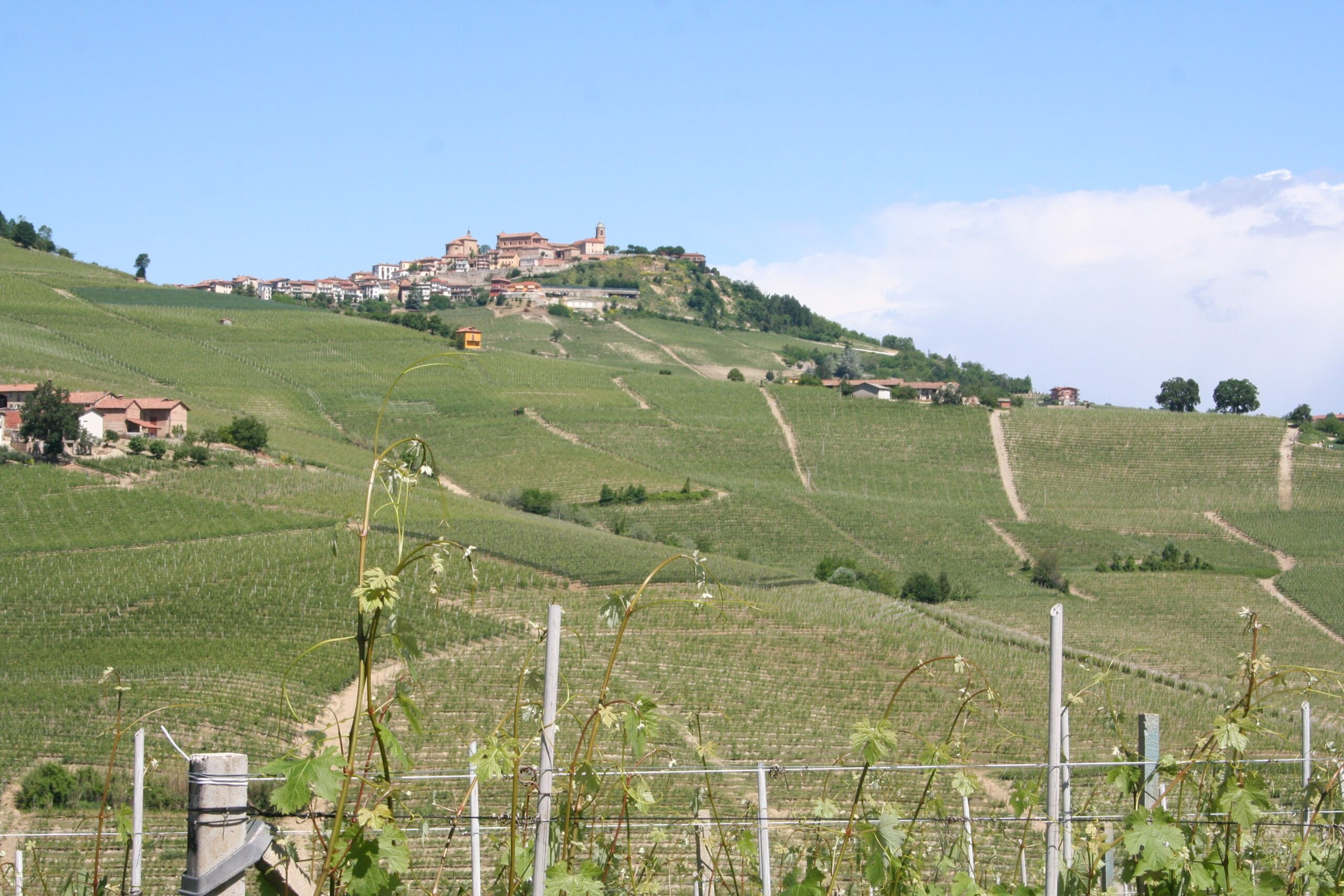
In La Morra, an eighteenth-century building leans against a medieval tower and looks down over the Barolo valley and the road that winds up from Alba. It holds the cellars of Poderi Marcarini, a family that has made Barolo here for six generations and was printing a vineyard name on its labels as early as 1958. It also looks after something rarer than any cru: half a hectare of Dolcetto vines that have never been grafted.
A general, a notary and a partner named Cogno
The family dates its story to the mid-1800s, when General Sebastiano Marcarini, tutor to the children of King Vittorio Emanuele II, made Barolo for his household and as gifts for receptions at the Savoy court. His son Giulio carried the work on, and on 30 June 1934, the estate's history says, he was among the growers who founded the Consorzio dei Vini Tipici di Barolo e Barbaresco in Alba.
The commercial turn came with the notary Giuseppe Marcarini, who began selling bottles under his own brand with his daughter Anna. He then went into partnership with his oenologist, Elvio Cogno, the same Cogno who appears in our Nascetta story, and in the 1960s their Barolo went out as Cogno-Marcarini. The family calls the house a pioneer of naming the vineyard on the label, with Brunate on its bottles from 1958.
After Giuseppe's early death, from the 1980s Anna expanded the 4.5 hectares in the Brunate and La Serra crus, added Dolcetto and Barbera to the range, and gave the name Lasarin to the Nebbiolo from La Serra's youngest vines.
Luisa, Manuel and the sixth generation
In 1990 Anna's daughter Luisa, whose father was the lawyer Giovanni Bava, founded Poderi Marcarini. She was 26, and her husband Manuel Marchetti, 30, brought experience as an international manager, the estate says. An older profile on the British site Wine Pages adds that he was born in Guatemala, where his father, a Cinzano executive, was setting up a winery.
The couple bought half a hectare at Berri, six hectares of vines and two of hazelnuts at Neviglie, and two more hectares in the Roero. Their children Andrea, Chiara and Elisa have since joined the business. The site's history page gives almost 20 hectares of vines in total, its vineyard page 25, planted only to Nebbiolo, Dolcetto, Barbera, Arneis and Moscato bianco.
Brunate and La Serra
Brunate comes from 4.5 hectares across the comuni of La Morra and Barolo, at about 300 metres, facing south and south-west on calcareous clay with a marked share of magnesium, planted in 1978 and 1987. The estate says the hill was counted among the great crus of the Langa as early as the 1300s, and is proud to be called traditionalist. The skins stay submerged in the fermenting wine for at least four weeks, and after the malolactic the wine spends two years in Slavonian oak casks of 20 to 40 hectolitres. Since 2015 the bunches have been sorted during the harvest.
La Serra sits higher, at about 380 metres, on 4 hectares planted in 1992 and 2002. Its soils, the estate writes, are poor in organic matter but rich in mineral salts, with a light, fresh and dry air movement. It ripens a little later than Brunate and gives wines that the family calls very elegant and "only apparently" less structured (our translation). It is made the same way and bottled unfined and unfiltered.
A third Barolo, Del Comune di La Morra, arrived in 2015 with the new generation: grapes from several historic La Morra vineyards vinified together to show the commune's Tortonian soils in a wine that is ready sooner. Its 2022 is among the Piemonte wines awarded the Corona in Vinibuoni d'Italia 2027.
Boschi di Berri, the vines on their own roots
The estate's most unusual bottle is Boschi di Berri Pre-fillossera, a Dolcetto d'Alba from half a hectare in La Morra planted at the end of the 1800s. The tech sheet lists the rootstock simply as "viti franche": the vines grow on their own roots, a rare example, the estate writes, of vines not grafted onto American rootstock. The estate puts the vineyard's survival down to its partly sandy soil and its microclimate. It lies at about 400 metres, faces west and carries 4,400 vines per hectare, trained on Guyot. Wine Pages reported that the old vines are propagated within the vineyard itself to renew the stock.
The family describes violet and raspberry on the nose, ripe cherry and currant in the mouth, and a wine that recalls what traditional Dolcetto must have been at the end of the 1800s. It suggests it with roasts, white meat and fresh cheese. This autumn Gambero Rosso named it among its Vini Rari, as our Tre Bicchieri 2027 round-up reported.
The everyday bottles, and how to visit
Lasarin is a Langhe Nebbiolo from the youngest Barolo vines and from Neviglie, macerated on its skins for about ten days at a relatively low temperature and matured to keep its freshness. Fontanazza is a Dolcetto d'Alba with no oak, which the family calls the daily wine of the Langhe. Ciabot Camerano, a Barbera d'Alba from some of the sunniest sites, is fermented in the traditional way and aged in Slavonian oak casks. The whites are a Roero Arneis from Montaldo Roero and a Moscato d'Asti from the Sargentin vineyard in Neviglie.
A notice posted on the estate's site in October 2025 says EU Next Generation funds will help it build a new cellar and modernise its vineyard and cellar machinery.
Visits start at the Wine Shop, open since 2013 on Via Umberto I 34 in the centre of La Morra. Staff lead private tours through the old cellars, followed by a tasting chosen to suit each visitor. Book by email at wineshop@marcarini.it or on +39 0173 50222.
Sources
- https://marcarini.it/la-storia/
- https://marcarini.it/i-vigneti/
- https://marcarini.it/la-cantina/
- https://marcarini.it/visite-in-cantina/
- https://marcarini.it/i-vini/ and the estate's tech sheets for Brunate, La Serra, Del Comune di La Morra, Boschi di Berri, Lasarin, Fontanazza and Ciabot Camerano (marcarini.it/wp-content/uploads/2023/03/)
- https://marcarini.it/wp-content/uploads/2025/10/GREEN-AND-CIRCULAR-WINE.pdf (October 2025)
- https://vinibuoni.it/i-vini-della-corona/ (Edizione 2027)
- https://wine-pages.com/tasting-articles/marcarini-piedmont-italy-with-manual-marchetti/