iDivini: Two Belgian Designers, Thirteen Wines and a Lot of Love
An afternoon tasting with Anna at a small Isola d'Asti winery where design, sustainability and a revived Tinella meet.
Il Vino Bello ·
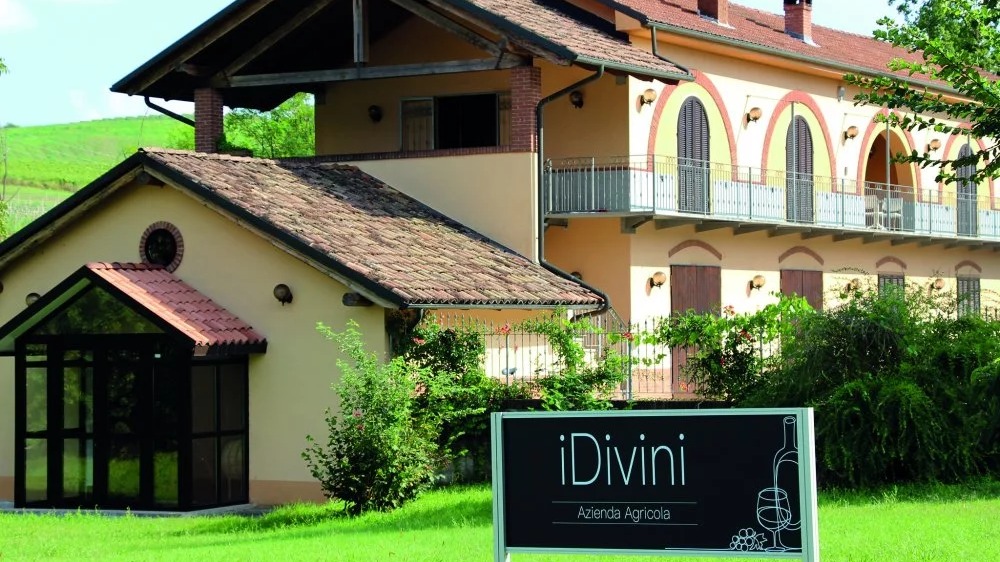
Some of the best visits are the ones you can walk to. iDivini sits in a fold of the Monferrato hills just outside Isola d'Asti. The cream-colored farmhouse has arched windows and a long balcony, and vineyards run right up to the cellar door. From the courtyard at sunset you can see the old village on its hilltop across the valley. It's the sort of view that explains why two people would leave their careers in another country to come and make wine here.
From Belgian interiors to Piemonte cellars
Koen and Anna are Belgian, and both used to work as interior designers. They founded iDivini in 2018 and have spent the better part of a decade since then learning this landscape vine by vine, alongside a local team who have known these hills all their lives. Koen still runs his design work alongside the vineyard. When he's away, Anna runs the winery, and she does it with remarkable care. Almost every bottle that leaves the cellar has been through her hands at some point: the winemaking, the bottling, the labelling, and the small decisions that keep a business like this balanced.
Their design training shows everywhere. The cellar is lined with engraved barrels and chalkboard labels. The wines have names in Piemontese dialect, each with a story behind it. The labels are artworks in their own right, and the wooden boxes are designed as proper gift boxes, the kind you keep after the bottle is gone. Very few wineries this size think this carefully about how their wine looks in your hands.
Small, local and sustainable
iDivini makes around 55,000 bottles a year across a range of thirteen wines. That's a lot of variety for a small cellar, and it reflects their curiosity. They work mainly with local grapes, including Barbera, Freisa, Cortese and Nebbiolo, plus Pinot Nero, which has grown in Piemonte for a long time. The vineyards are on white chalk and loam right next to the cellar. Sustainability is a stated goal alongside quality, and the estate doesn't use insecticides or herbicides. Much of the creativity at iDivini goes into finding better ways to run the place, not only into what ends up in the bottle.
The tasting
We tasted with Anna, and the range is impressive.
The whites. Piasi in Silensi ("enjoy in silence") is a steel-fermented Cortese, floral and mineral, made for an aperitif on a warm terrace. Its sibling L'Òr in Boca ("gold in the mouth") takes the same grape into small oak and acacia barrels, and comes out rounder, golden, with tropical fruit and a soft vanilla edge. Perché No ("why not") is a lively Sauvignon Blanc, half oak and half steel, full of citrus and passion fruit.
Bubbles and a summer rosé. La Pricca is a Metodo Classico of Pinot Nero and Cortese with 24 months on the lees: fine bubbles and a touch of brioche. Ciao Sole ("hello sunshine") is a dry rosato made from Barbera free-run juice. It's bright pink and smells of wild strawberries, and it's pure summer.
The staples. Barbera comes in two styles. Pian di Rös is named after the poppies in the vineyard behind the winery and is young, fresh and cherry-bright. Sotto la Luna ("under the moon") is the Superiore, with a year in small oak, fuller and spicier. Podèj dla Tèra ("power of the earth") is their Monferrato Nebbiolo, aged two years in large casks.
The smoky Freisa. One wine stood out from everything else: Cadò dla Tèra ("gift of the earth"), a Freisa d'Asti Superiore. Freisa is usually drunk young and fresh. iDivini gives it twelve months in small oak barrels and another year in bottle, and that ageing turns it into something you rarely find: rose and raspberry from the grape, wrapped in a smoky, spicy depth that belongs to this cellar alone. It's full-bodied and round, with a long finish. We'd strongly recommend it with a board of aged cheeses or a plate of wild game.
Blends and Pinot Nero. Favor dël Demòni ("the devil's choice") blends Barbera, Freisa, Pinot Nero and Merlot. Each grape is aged on its own for a year before blending, and the result is complex, round and elegant. Balèt dël Àngel ("the angel's dance") is a pure Pinot Nero from their own vineyards, aged a year in oak. It has strawberry and red currant, soft tannins and a fresh, light-footed finish.
Tinella. The highlight of the afternoon came last. iDivini is one of only six wineries in the area that have brought back Tinella, a legendary local wine that had all but disappeared. Their version spends more than two years in oak, and you can taste every month of it. The wood has softened and rounded everything, so the wine glides across the palate, smooth and generous, with no hard edges. It's deep and layered but never heavy, and it's simply delicious, the kind of glass you find yourself reaching for again before you've finished talking about the first one. It was the bottle we talked about all the way home. If you visit iDivini, make sure Tinella is on your tasting list. Highly recommended.
To finish, there's the sweet and fragrant Asti Spumante, and two vermouths built on the estate's own wines. The Vermouth Rosso di Torino uses oak-aged Barbera as its base, not white wine colored with caramel, and the Vermouth Bianco di Torino is made from their Sauvignon Blanc. Both are excellent over ice with a twist of citrus.
Why you should go
The wines are reason enough. What stays with you, though, is Anna's passion for wine, for winemaking, for Piemonte and for life itself. It's hard not to be won over. iDivini is the sort of place that reminds you why this part of the world gets under your skin. We can't wait to go back.
Plan your visit: Tastings run from a cellar visit with four wines and a cheese and salami plate (€20) to a two-hour aroma journey with five wines and food pairing (€50). Open Monday to Friday 14:00 to 18:00, weekends by appointment. Via Valle Nabisso 5, Isola d'Asti. See iDivini on Il Vino Bello for booking details.
Sources
- Our own visit and tasting at iDivini, October 2026
- iDivini: https://www.idivini.org/
- Winetourism.com, iDivini: https://www.winetourism.com/winery/idivini/