Alladium: Cieck's Erbaluce Passito, Dried Through the Canavese Winter
How a San Giorgio Canavese estate turns racks of drying Erbaluce into a sweet wine aged at least five years in oak.
Il Vino Bello ·
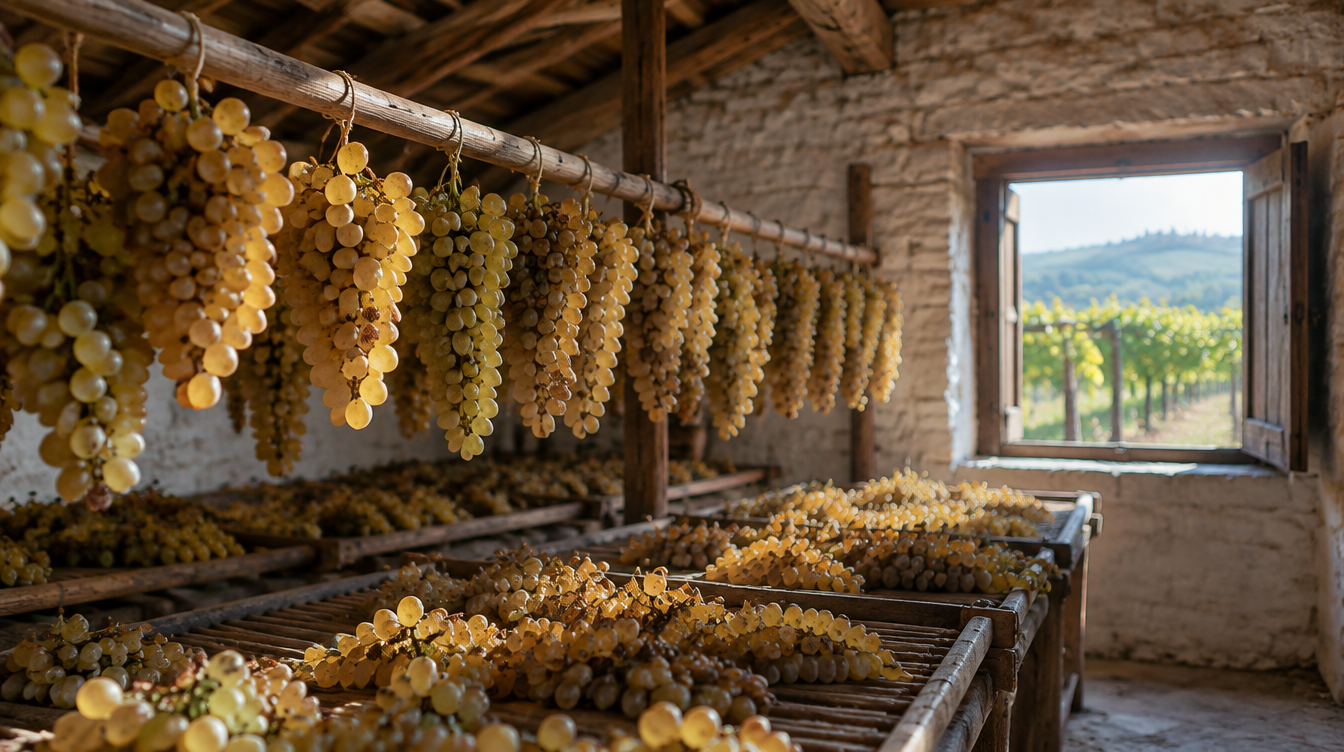
In early October, while most of Piemonte is busy with presses and fermenting tanks, a few cellars in the Canavese are doing something much slower. The best Erbaluce bunches are set aside, hung up on racks and left to dry until the new year. At Cieck in San Giorgio Canavese, that patient work becomes Alladium, the estate's traditional Erbaluce passito.
The Canavese and its white grape
Erbaluce di Caluso sits at the far north-western edge of Piemonte's wine map, between Turin and Ivrea. The production rules list some three dozen comuni across the provinces of Turin, Vercelli and Biella, with vineyards between 200 and 500 metres on the moraine soils left behind by the glacier that shaped the Ivrea basin. The denomination became a DOC in 1967 and a DOCG in 2010, and it is made only from Erbaluce.
The grape has a long paper trail: Giovan Battista Croce mentioned it as "Elbalus" in a text from 1606. It is traditionally grown on the Canavese pergola, which the rules describe as rows more than five metres apart with about a thousand vines per hectare, pruned long because Erbaluce is not fruitful on its first three or four buds. Its bunches are not very compact, which makes them fairly resistant to grey rot and well suited to drying. The same grape gives a dry white, a traditional method sparkling wine and a passito, all under one name.
What the rules ask of a Caluso Passito
The passito is the most demanding of the three styles. The disciplinare sets out a few clear requirements:
- Bunches must be carefully sorted, then dried until their sugar content reaches at least 29 per cent.
- No more than 35 litres of wine may come from 100 kilos of fresh grapes, half the yield allowed for the dry wine.
- The wine must age for 36 months from 1 November after the harvest (48 months for the Riserva), and may not be sold before 1 November of the third year (the fourth for the Riserva).
- At release it needs at least 70 grams per litre of residual sugar and a total alcohol of 17 per cent, a figure that counts the unfermented sugar as potential alcohol. Colour may range from gold to dark amber.
The rules also note what makes the style local: grapes for the passito are laid out on racks in dedicated rooms to dry naturally.
How Cieck makes Alladium
Cieck was founded in 1985 by Remo Falconieri, who trained in France in traditional method winemaking and bottled the estate's first Erbaluce metodo classico that year. Today the estate farms 13 hectares, almost all Erbaluce, on pergola-trained vines. According to the estate's details on our wine page, Alladium was first made in 1985 and takes its name from the Latin name of Agliè.
The grapes come from vines of around 30 years on moraine soils at about 320 metres, facing south and south-west. The estate selects the healthiest bunches with the thinnest skins and hangs them on traditional racks for four to five months, from September to January or February. The drying is managed to keep grey mould away while letting noble rot develop. In January the grapes are pressed gently in a small wooden press, and the cold must is left to settle before it ferments.
Then comes the long part. Alladium ages for at least five years in small French and Slavonian oak barrels, which are topped up from time to time as the wood absorbs some of the wine, and then rests six months in bottle. That is well beyond the 36 months the rules require.
What the estate describes in the glass
Cieck describes Alladium as shimmering old gold, with a bouquet of unrefined honey and candied lemon, aromatic and musky. On the palate the estate speaks of a sweet, fresh wine with a broad structure, warm and velvety, finishing with a touch of freshness.
For the table, the estate suggests pastries, dried fruit and nuts, blue cheeses, terrines and pâtés, and it presents Alladium as a meditation wine or an unusual aperitif, served at 12 to 14°C. In the best years Cieck also makes Alladium Riserva from bunches chosen one by one and aged at least ten years in barrel. The estate describes it as amber, with dried fruit and nuts, chestnut honey, candied fruit and roasted coffee beans, and an almond finish.
More Erbaluce to explore
Cieck's range shows how far one grape can travel. Vigna Misobolo is a single-vineyard dry Erbaluce from a plot farmed since the 1970s, while Calliope and Nature are traditional method sparkling wines.
In the same village, Orsolani puts about 90 per cent of its production into Erbaluce and makes its own passito, Sulè. For another dry Erbaluce, look at Merlana from Vite Colte. If you open a passito this winter, it is worth remembering that the grapes for a future bottle are hanging up to dry right now.
Sources
- https://www.valoritalia.it/wp-content/uploads/2020/06/Erbaluce-di-Caluso-o-Caluso.pdf
- https://it.wikipedia.org/wiki/Erbaluce_(vitigno)
- https://www.orsolani.it/la-nostra-storia