Barolo Chinato: Chocolate, Bonèt and Piemonte's Bittersweet Nightcap
A pharmacist's cold remedy made from Barolo, and what to eat with it, from dark chocolate and bonèt to a warm glass with orange peel.
Il Vino Bello ·
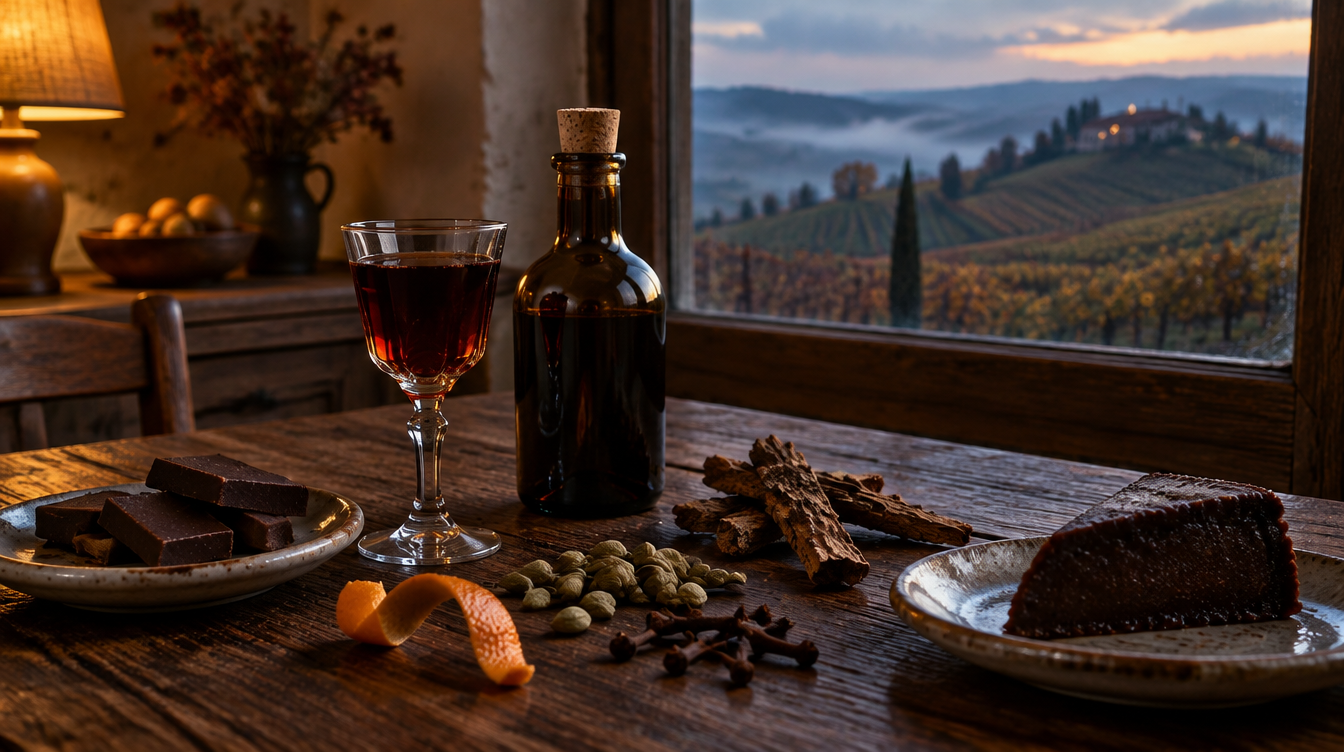
Barolo Chinato is Barolo turned into a bittersweet after-dinner drink, spiked with cinchona bark and a secret mix of herbs. It started life as a pharmacist's remedy for colds, which makes it good company now that the evenings in the hills are turning cold. Here is where it comes from, what goes into it, and what to put next to it, from a square of dark chocolate to a slice of bonèt.
A pharmacist's remedy made from Barolo
The usual story starts at the end of the 1800s. According to the Cappellano family, Giuseppe Cappellano, a pharmacist from Serralunga d'Alba with a shop in Turin, worked out the original recipe and offered it as a "soothing medicinal and anti-malarial remedy" (our translation). The family's own history points to Turin's vermouth, born in the late 1700s, as the probable inspiration. The regional tourist board, Ente Turismo Langhe Monferrato Roero, credits two pharmacists rather than one: Dr. Cappellano of Serralunga and Dr. Zabaldano of Monforte d'Alba, who made it to fight small ailments, colds above all.
Asti claims a share too. Giulio Cocchi, a young pastry maker from Florence, set up his business there in 1891 and created original recipes for Barolo Chinato, vermouth and aperitifs. The house says he was the protagonist of the drink's spread, through tasting shops opened in Piemonte and Liguria in the early 1900s. The tourist board writes that chinato faded between the 1950s and the 1970s, as the farming culture around it changed. Ceretto counts itself among the champions of its revival in the late 1980s, and Cocchi, owned by the Bava family since 1978, lists saving Barolo Chinato from oblivion among its achievements of the last thirty years.
What goes into the bottle
The base is Barolo DOCG, at least 75 per cent according to the tourist board, with cinchona bark (china calissaja) for the bitterness, plus herbs and spices such as rhubarb root, gentian and cardamom, sugar and alcohol. Every house keeps its exact list to itself. At Cappellano the spices are ground by hand in a cast iron mortar and macerated in alcohol for about a month, then joined with sugar and aged Barolo, left to rest and bottled without filtering.
Other houses describe their own versions:
- Borgogno works from a family recipe dating to the 1920s: 46 herbs macerated for 35 to 70 days, with two kinds of cinchona, Calisaya and Soccirubra.
- G.D. Vajra describes 85 per cent Barolo Albe and 15 per cent infusions of about thirty herbs, barks and roots, with Sicilian orange peel and cane sugar.
- Rocche Costamagna steeps cinchona and 27 other spices and herbs in the wine for ninety days, then rests the bottles for ninety more before release.
- Costa di Bussia follows the recipe of its pharmacist founder, Luigi Arnulfo.
Chocolate, the match that should not work
Cappellano describes dark chocolate as an "almost impossible" pairing that its chinato can hold. Cocchi and the tourist board use almost the same words: chinato as the "ideal liquid" to stand up to even the richest, most cocoa-heavy chocolate. The chocolatier Andrea Slitti created a Barolo Chinato praline, which Cocchi hands out at tastings to show the match.
The producers' own suggestions go further. Rocche Costamagna recommends chocolate at 70 to 80 per cent cocoa. Schiavenza suggests chocolate, especially bonèt. F.lli Rovero adds Piemonte hazelnut cake and cream ice cream. For the adventurous, Cantina Sociale di Nizza suggests its Barbera chinato Cesco with foie gras or aged gorgonzola.
Neat, warm or over ice
Cocchi describes the traditional use plainly: in Piemonte chinato became the main antidote to small ailments, colds above all, drunk hot like mulled wine, and offering it to guests was a ritual of farmhouse hospitality. Today it suggests serving it at room temperature at the end of a meal, or warmed with steam and a strip of orange peel. Rocche Costamagna gives 17 to 18 °C for the neat glass.
It is not only for after dinner. Borgogno says to enjoy it "as you wish": neat, on ice, with hot water, with dark chocolate, as an aperitif or even as a herbal tea, and recalls Cesare Borgogno calling it a "natural restorative". Giovanni Sordo suggests an aperitif with soda water, bitter orange and ice.
Beyond Barolo, and bottles to look for
Not every chinato starts from Barolo. Borgogno also makes a Chinato on a Langhe Nebbiolo and Barbera d'Alba base, Rovero builds Calisaya on Barbera d'Asti, and in Tassarolo, in the Gavi area, Castello di Tassarolo makes Adagio from Barbera, which the producer says can age for more than twenty years after bottling.
If you want to compare the Barolo versions, the site lists, among others, Cocchi, Ceretto, Cagliero and Paesi Tuoi from Vite Colte. Several, like Rocche Costamagna's and Costa di Bussia's, come in half-litre bottles. Cocchi's advice once one is open is simple: put the cork back in.
Sources
- https://www.cappellano1870.it/it/i-vini-it/barolo-chinato-it.html
- https://www.cappellano1870.it/it/il-barolo-chinato-it.html
- https://www.cappellano1870.it/it/il-segreto-it.html
- https://www.cocchi.it/vini/barolo-chinato/
- https://www.cocchi.it/cocchi/storia/
- https://www.visitlmr.it/it/vini/barolo-chinato
- https://ceretto.com/uploads/public/2044_en-ceretto-barolo-chinato.pdf
- https://www.borgogno.com/en/wines/barolo-chinato/