Alta Langa: How Piemonte Built a Sparkling Wine in the High Hills
Seven sparkling-wine houses, vineyards above 250 metres and at least 30 months on the lees: the short story of Alta Langa DOCG.
Il Vino Bello ·
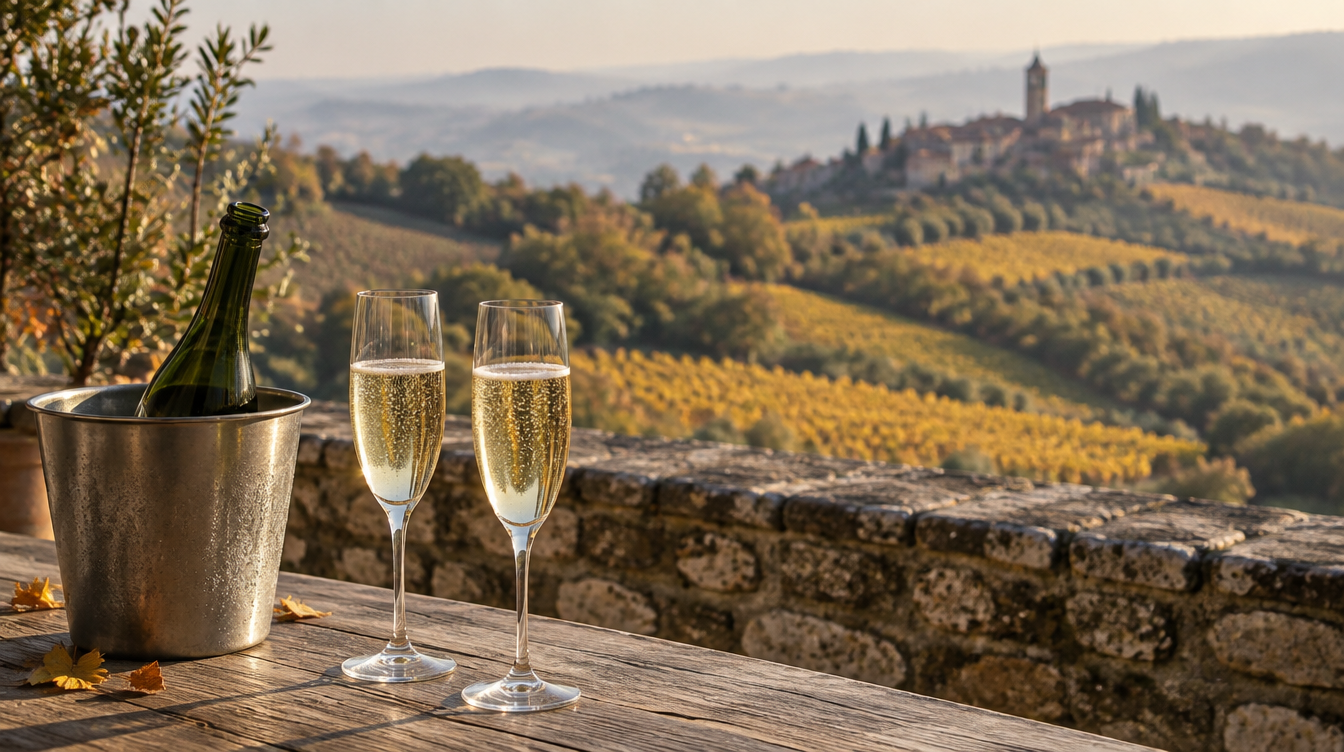
Piemonte was making spumante in the 1860s, yet its own metodo classico denomination is young: the Consorzio Alta Langa turned 25 this June. If you have seen "Alta Langa" on a wine list and wondered what sits behind the name, here is the short version: who built it, what the rules demand, and which bottles on the site show its range.
A sparkling wine with a long memory
Piemonte's claim on Italian sparkling wine is old. According to the consorzio's own history, Carlo Gancia went to Reims after studying oenology in 1848 and by 1865 had worked out how to make Italian spumante in Canelli.
The modern story starts on 28 February 1990, when seven Piemonte sparkling-wine houses (Cinzano, Contratto, Fontanafredda, Gancia, Martini & Rossi, Riccadonna and Vini Banfi) signed up to a shared experimental project. By 1992, 21 growers were involved with around 20 hectares, planted 85 per cent to Pinot Nero and 15 per cent to Chardonnay, and the experimental vineyards eventually reached 57 hectares. The Consorzio Alta Langa was founded in Asti on 15 June 2001, the DOC followed on 23 November 2002, and the DOCG came in March 2011, applied back to the 2008 harvest.
What the rules actually say
The production rules are short and strict, which is a large part of the appeal.
- Grapes: Pinot Nero and/or Chardonnay make up 90 to 100 per cent; up to 10 per cent can be other non-aromatic varieties.
- Where: hillside vineyards on the right bank of the Tanaro, in the provinces of Asti, Alessandria and Cuneo, never below 250 metres above sea level. The consorzio's zone page counts 149 comuni; the disciplinare lists 150.
- Method: always metodo classico, with the second fermentation in bottle.
- Time on the lees: at least 30 months, and 36 months for a Riserva. A rosato version is allowed on the same terms.
- Vintage: always stated on the label. There is no non-vintage Alta Langa.
- Sweetness: demi-sec, sec and sweet versions are excluded, so Alta Langa is always a dry style.
The altitude rule is the one behind the name, the "high" Langa. The consorzio describes the hill soils as marly and calcareous-clay, with moderate fertility.
A small denomination, still growing
Alta Langa is still small. In an interview with consorzio president Giovanni Minetti, published by Targatocn in February, production was put at a little over two million bottles, not enough to meet rising demand, with growth of a further 10 per cent and 80 to 85 per cent of bottles staying in Italy. The same piece announced a first New York date, on 10 March, with forty wineries.
Picking comes early. This year the consorzio announced that picking of Pinot Nero and Chardonnay for its base wines would start on 5 August, an early date after a warm season. Its vice president, Gianmario Cerutti, said at the time that heat peaks speed up and suddenly change ripening curves, which makes careful vineyard work and constant monitoring essential.
Bottles to look for on Il Vino Bello
Because the rules are tight, much of the difference between producers comes from altitude, the blend and time on the lees. A few on the site show the range:
- Deltetto names its two Riserva Brut Nature wines after vineyard height: Blanc de Noirs 570m and Blanc de Blancs 480m, both fermented in used French barriques and aged at least 42 months on the lees.
- Enrico Serafino makes Zero 140, a Pinot Nero Riserva that rests at least 140 months, almost 12 years, before disgorgement, from vines at 450 to 550 metres around Mango, Loazzolo and Bubbio.
- Fontanafredda, one of the original seven houses, releases its single-parcel Vigna Gatinera Pinot Nero at several ages; the 120 Mesi Riserva is from 2015 and was disgorged after 120 months.
- Marcalberto makes Nature, a Pinot Nero with no added sulphites from vineyards at 250 to 620 metres; the producer suggests it with snails and truffle dishes.
- Vite Colte gives a classic starting point in Cinquecento, a Pinot Nero and Chardonnay Brut with a minimum of 30 months in bottle, from vineyards at an average of 500 metres.
Where to taste it this autumn
The consorzio has worked with the Fiera Internazionale del Tartufo Bianco d'Alba since 2017, and this year it is back at the 96th edition, which runs from 10 October to 6 December 2026. The most useful sessions for anyone curious about the denomination are the guided blind tastings of four Alta Langa wines with AIS Piemonte, on Saturday 31 October and Saturday 21 November at 11.30 and 16.30. They are built around exactly the questions above: grape, time on the lees and where the vineyards sit. Check the fair's site for booking before you go.
Sources
- https://www.altalangadocg.com/consorzio-alta-langa/la-storia/
- https://www.altalangadocg.com/consorzio-alta-langa/disciplinare-produzione/
- https://www.altalangadocg.com/alta-langa-docg/la-zona-produzione/
- https://www.qualivita.it/news/consorzio-alta-langa-ed-ente-fiera-internazionale-del-tartufo-bianco-dalba-10-anni-di-valori-condivisi/
- https://www.targatocn.it/2026/02/03/leggi-notizia/argomenti/attualita/articolo/alta-langa-docg-non-rincorriamo-i-volumi-costruiamo-valore-2.html
- https://www.alimentando.info/alta-langa-docg-al-via-la-vendemmia-2026/