Moscato d'Asti: The Sweet Sparkler Piemonte Makes All Year Round
Why the region's low-alcohol Moscato waits in chilled tanks after the harvest, and is fermented in small batches through the year.
Il Vino Bello ·
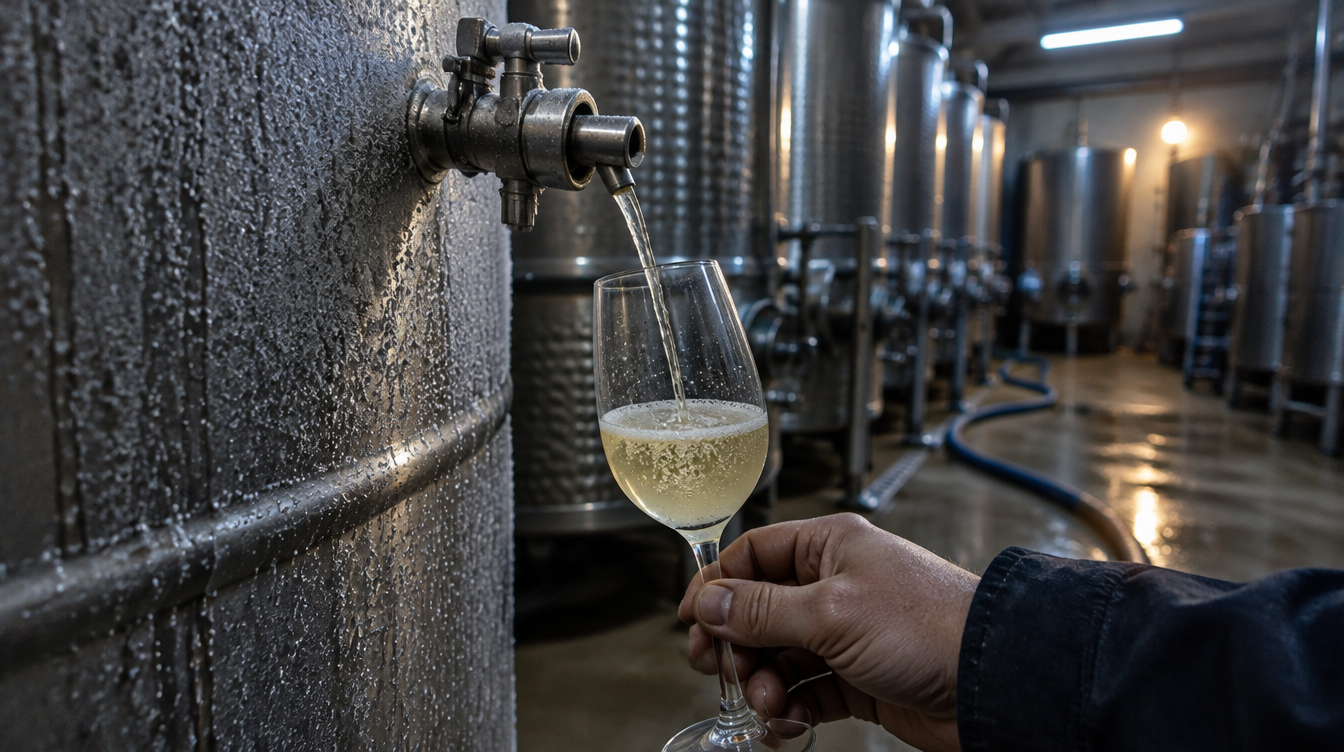
The Moscato harvest in the hills around Canelli, Santo Stefano Belbo and Castiglione Tinella ended weeks ago, but in many cellars the 2026 Moscato d'Asti is only half begun. Much of it is sitting in steel tanks as sweet, chilled grape juice, waiting its turn. That is the quiet trick behind what the Regione Piemonte calls the region's most widespread wine in the world: it is finished a little at a time, through the year, so that it reaches the bottle fresh.
The grapes come in early
This year the grapes came in early. Giacomo Pondini, director of the Consorzio dell'Asti, told Wine Meridian on 30 September that while picking had begun in the second half of August in recent years, in 2026 it started around Ferragosto, or even before in the quickest-ripening spots. The consortium president, Stefano Ricagno, described the fruit to La Voce di Alba in early September as some of the healthiest he had seen, with some sunburn damage, mostly on the most exposed south-facing hilltops, the sorì.
Quantity is managed as tightly as quality. The rules allow 10 tonnes of grapes per hectare, but for 2026 the Regione Piemonte, at the consortium's request, cut the classifiable yield to 8.5 tonnes, with up to 1.5 tonnes more set aside as aromatic Moscato must. The decree, dated 24 July, gives the reason plainly: keeping supply in balance with sales and stocks.
Juice in the cold
What happens next is the heart of it. The grapes are pressed gently and the juice is chilled at once so it cannot start to ferment. Vietti describes its must being "stored at a very low temperature in stainless-steel tanks to avoid spontaneous fermentation". Cantina Sant'Evasio in Nizza Monferrato says its juice is taken to zero degrees and held there in autoclave; Massimo Abbate in Coazzolo rests his for about 20 days in a cold room at 0 °C before anything else happens.
The production rules, the disciplinare of the Asti DOCG, write this into law. Refrigeration, they say, may be used to conduct the fermentations "nell'arco dell'intera annata", over the whole year, so as to keep "il giusto rapporto tra alcol effettivo e zuccheri residui", the right balance between alcohol and leftover sugar (our translation).
Fermented in batches, stopped halfway
When a producer needs wine, a portion of that cold must goes into an autoclave, a sealed steel tank built to hold pressure. Vietti warms its batches to 12 to 14 degrees to start the yeast and, at about 5.5% alcohol, chills the tank quickly to stop it. Because the tank is closed, the carbon dioxide from fermentation stays in the wine. That is where the gentle prickle comes from, and the rules require that it come only from fermentation.
The disciplinare sets the limits. A Moscato d'Asti must have between 4.5% and 6.5% alcohol actually fermented, within a total potential strength of at least 11% counting the sugar still in the wine, and its overpressure may not exceed 2.5 bar at 20 °C. The rules also forbid the mushroom cork and wire cage of a sparkling wine, and crown caps, so a Moscato d'Asti is closed like a still bottle. The fizzier Asti Spumante, from the same grape and area, is a separate type with at least 6% fermented alcohol and more pressure, usually made by the autoclave method that Federico Martinotti, born in Villanova Monferrato, introduced in 1895.
The numbers on the site's tech sheets show how much sweetness is left behind. Ghiga in Castiglione Tinella stops at about 5% and 1 to 1.2 bar, with around 120 to 130 grams of sugar per litre; Abbate stops at 5.5% and 2.5 bar by dropping the tank to minus 4 °C, with about 120 grams. Vietti adds that its wine does not go through malolactic fermentation and is bottled with sterile filtration, which keeps it from starting again.
Why it matters when you buy
The practical lesson is freshness. A Moscato d'Asti is finished batch by batch, close to when it is bottled, and producers on the site such as Fratelli Savigliano say theirs is to be drunk within a year. The first of the vintage is already on its way: Collina Serragrilli in Neive says its Moscato, from the first grapes of its harvest, is bottled in November and ready by 20 December. Look for the vintage on the label and pick the youngest on the shelf.
The method also explains a few labels that break the rule on purpose. Ca'd'Gal in Valdivilla leaves the must for Vigna Vecchia on its yeasts at 0 °C until the following spring, then ages the bottles for 60 months in cases of sand. Dogliotti 1870 ferments part of its Erik in oak with indigenous yeasts and rests it at least 18 months in bottle, to move past the classic linalool-driven aroma of young Moscato. These are exceptions, made by stretching the same cold, patient process.
Where it comes from
The DOCG covers 51 comuni across the provinces of Asti, Cuneo and Alessandria and nearly 10,000 hectares, according to the Regione Piemonte, which picked the Asti DOCG as its wine of the year for 2026 and says about 90% of the roughly 100 million bottles a year are exported. The disciplinare asks for at least 97% Moscato bianco, from hillside vineyards, preferably on calcareous soils, and names two subzones, Santa Vittoria d'Alba and Strevi. Canelli now has a DOCG of its own, which the Regione dates to 2023.
For a first taste of how different hills read, try the Caudrina estate's namesake Moscato alongside one of the Castiglione Tinella bottles above. And do not save them only for dessert. Ricagno points out that abroad the wine is chosen at all hours: as an aperitivo, with savoury food, in cocktails, at five o'clock tea or for a toast at eleven in the morning.
Sources
- https://www.regione.piemonte.it/web/sites/default/files/media/documenti/2025-01/docg_asti_disciplinare_di_produzione.pdf
- https://www.regione.piemonte.it/web/sites/default/files/media/documenti/2026-07/dd-a17-752-2026_asti.pdf
- https://www.regione.piemonte.it/web/node/22239
- https://www.winemeridian.com/approfondimenti/esperienze-aziendali/intervista-giacomo-pondini-asti-docg-vendemmia-settembre-2026/
- https://www.lavocedialba.it/2026/09/02/leggi-notizia/argomenti/agricoltura-6/articolo/asti-e-moscato-docg-verso-il-futuro-tra-versatilita-e-mercati-globali-1.html
- https://www.vietti.com/public/file/pdf/-20250328164822-Moscato-Asti--eng.pdf
- https://beverfood.com/onav-secolo-progresso-spumante-italiano-onore-felice-martinotti-wd/amp
- https://www.regione.piemonte.it/web/sites/default/files/media/documenti/2023-08/disciplinare_di_produzione_della_denominazione_di_origine_controllata_e_garantita_dei_vini_canelli.pdf