Dogliani DOCG: Dolcetto's Home Hills and the Names on the Label
Why Dolcetto has its own DOCG in the Bassa Langa, what Superiore means, and the village and vineyard names you may find on the label.
Il Vino Bello ·
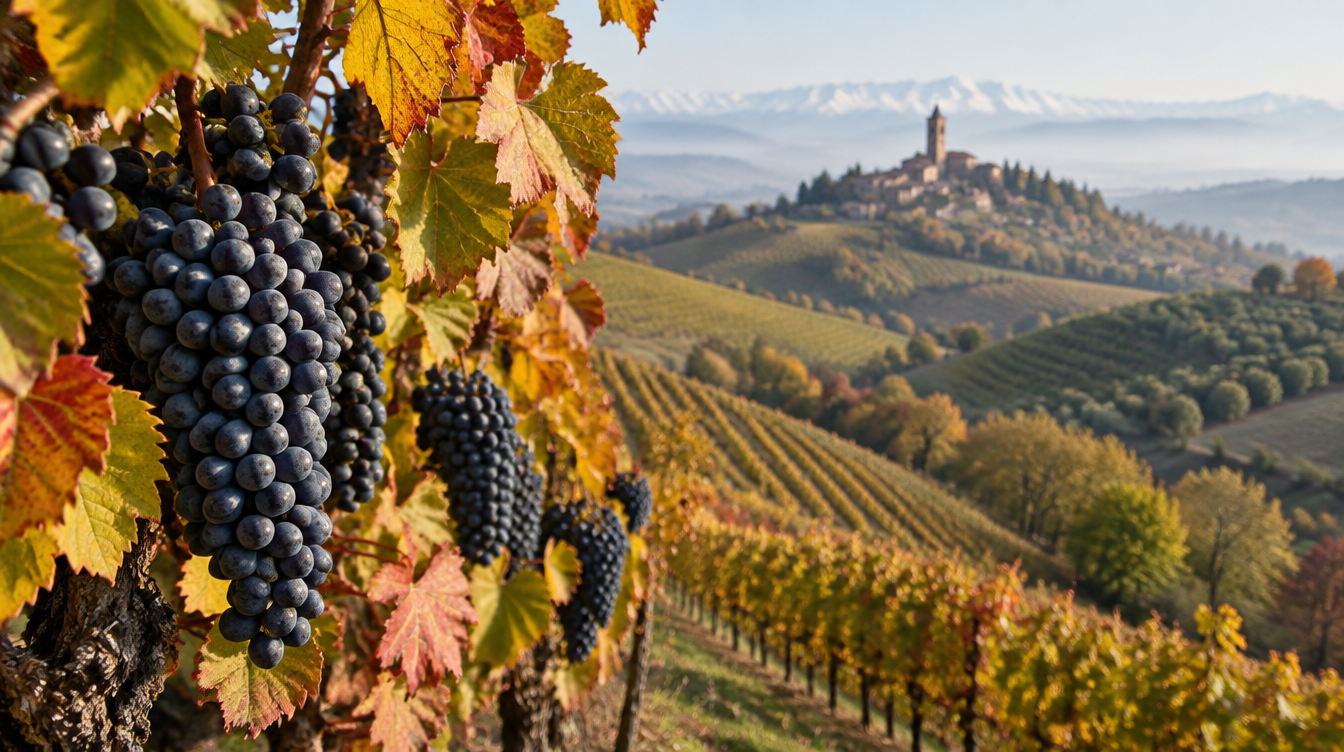
Most of Piemonte treats Dolcetto as the wine you open while the Barolo rests. In the hills around Dogliani it gets top billing: a DOCG of its own, a producers' association with a cellar in the old town hall, and a list of village and vineyard names that can appear on the label. Here is how the denomination works, and what to look for on the bottle.
A grape with a long paper trail
The first firm record of Dolcetto in Dogliani is a municipal ordinance from 1593. It forbade anyone to pick grapes before the feast of San Matteo, 21 September, without a permit from the town's deputy, on pain of losing the whole crop. The order names "dozzetti" grapes, which has been taken to mean Dolcetto, still called "duset" or "duzet" in local dialect. The name means "little sweet one", yet the wine is almost always dry; Wikipedia notes the name may come from the hills rather than the sugar.
The modern story runs through one family. In 1897 Luigi Einaudi, then 23 and, in the estate's words, "giovane e senza mezzi", bought his first farm at San Giacomo in Dogliani. He went on to become governor of the Bank of Italy and President of the Republic, and the estate's own history says he never missed a harvest. Poderi Luigi Einaudi still farms more than 29 hectares around Dogliani, mostly Dolcetto and Nebbiolo.
From DOC to DOCG in three steps
The rules arrived in stages. Dolcetto di Dogliani became a DOC in 1974. Ten years later, in 1984, local producers set up the Bottega del Vino Dogliani to protect and promote their wine. The DOCG followed with the 2005 vintage, as Einaudi's own page on its Vigna Tecc puts it.
The current denomination dates from 2011, when a new DOCG called simply Dogliani absorbed the earlier Superiore DOCG and the Dolcetto delle Langhe Monregalesi DOC. The zone grew with it. According to the Regione Piemonte, it now covers the whole of 14 comuni, including Dogliani, Farigliano, Clavesana, Belvedere Langhe and Monchiero, plus parts of seven more such as Carrù, Mondovì, Murazzano and Vicoforte. Langhe.net adds that valley floors and flat land are excluded, with a ceiling of 800 metres.
Dogliani or Dogliani Superiore
Both wines are 100 per cent Dolcetto, and the vintage must always be on the label. The main difference is time: according to the Regione Piemonte, the Superiore must age for at least 12 months. The rules say "superiore" has to be printed in the same size, colour and type as the word Dogliani, on the same line or just below it.
That year is a minimum, and producers read it very differently. Some keep wood out entirely: Giovanni Battista Gillardi ages Cursalet in steel or cement and bottles it the summer after harvest, and Raineri keeps Zovetto in steel for eight months, unfiltered. Others take longer. Einaudi matures Madonna delle Grazie Vigna Tecc in large French oak before bottling it at the end of the year. Chionetti gives San Luigi Vigna La Costa, its highest vineyard, three years between harvest and sale, while Cà Neuva ages its Dogliani Superiore for twelve to eighteen months in steel.
The names on the label
Since a 2018 ministerial decree, Dogliani has its own list of additional geographical mentions, the menzioni geografiche aggiuntive. There are 76 in all: the 21 comuni of the zone, which must be written as "del comune di" followed by the village, and 55 smaller places, each mapped down to the cadastral parcel. The word "vigna" with a vineyard name is allowed only alongside one of these names, in letters no more than half the size of Dogliani, and only by producers who make and bottle the wine themselves.
The list reads like a map of the bottles on our site. San Luigi is there, the cru behind Chionetti's San Luigi and also the name of wines from Pecchenino and Abbona. So is Pianezzo, home of Francesco Boschis, whose Pianezzo was first made in 1968. You will also find Valdibà (Osvaldo Barberis), Cursalet, Zovetto, Madonna delle Grazie, San Bernardo (Anna Maria Abbona) and Santa Lucia. A name on a bottle is not proof that it is being used as an official mention, but the list is a good guide to where the wine was grown.
Tasting it where it is made
The Bottega del Vino Dogliani sits in Piazza San Paolo, in the medieval cellars of the town hall, a former Carmelite convent. It works as a showcase for its members' wines, which you can taste and buy, and guided tastings with producers can be arranged. The Strada del Barolo lists it as open every day from 10.30 to 13.30 and 15.30 to 19.30, closed on Wednesdays.
At the table, the Ente Turismo Langhe Monferrato Roero calls Dogliani a wine for the whole meal: plin ravioli, tajarin with meat sauce or truffle, white meats, salumi and fresh cheeses, served at 16 to 20°C. Autumn is a good time to try two side by side, one young and one Superiore, and see how far a single grape can go.
Sources
- https://www.regione.piemonte.it/web/media/6422/download (Ministry decree of 26 October 2018 amending the Dogliani DOCG rules, with the list of additional geographical units)
- https://www.regione.piemonte.it/web/media/10790/download (Regione Piemonte, "2019 Anno del Dolcetto")
- https://langhe.net/vino/dogliani-docg/
- https://www.stradadelbarolo.it/vino/dogliani-docg/
- https://www.stradadelbarolo.it/en/members/bottega-del-vino-dogliani/
- https://www.visitlmr.it/it/vini/dogliani-docg
- https://www.poderieinaudi.com/cantina-poderi-einaudi/luigi-einaudi/
- https://www.poderieinaudi.com/cantina-poderi-einaudi/storia-cantina-poderi-einaudi/
- https://www.poderieinaudi.com/vigneti-poderi-einaudi/vigneti-san-giacomo-dogliani/
- https://www.poderieinaudi.com/vini-poderi-einaudi/dogliani-superiore-tecc/
- https://en.wikipedia.org/wiki/Dolcetto