Opening old bottles
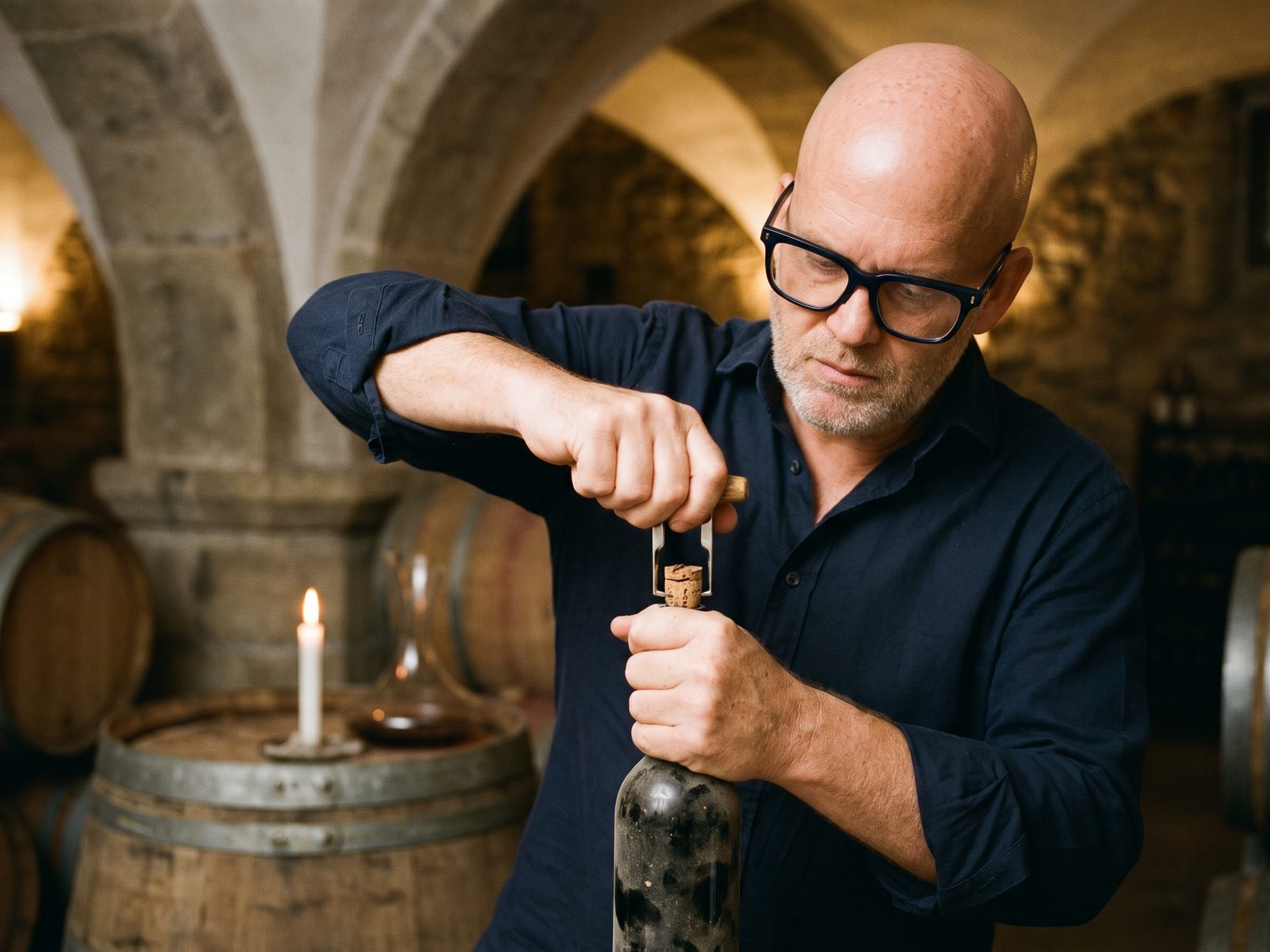
A twenty-year-old Barolo cork can be soft, dry and stuck to the glass. With the right tool, a day of rest and a slow hand it still comes out whole, and the wine reaches the glass clean.
Why it works
A cork ages along with the wine. For years it sits wet against the wine at one end and dry against the air at the other. The wet end swells and softens, the dry end shrinks and turns brittle, and the middle can bond to the glass. A normal corkscrew bites into the centre and pulls, and on an old cork that pull either tears a channel straight through or snaps the cork in two.
The answer is to grip the cork from the outside. The Ah-So, two thin flat prongs on a handle, slides down between cork and glass and lifts the cork as one piece, without piercing it. The Durand goes a step further: you screw a fine worm into the centre to hold the cork together, then slide Ah-So style prongs down the sides, and lift both at once. It is the tool most people who open old bottles regularly end up owning.
Old wine also carries sediment, and it is fragile once it meets air. So the job starts a day or two before dinner, by standing the bottle up, and ends with a careful decant and a wine you drink within an hour or two rather than leave open all evening.
What you need
- Ah-So two-prong cork puller: Lifts soft, fragile corks from the outside without piercing them.
- Durand cork puller (optional): A fine worm and Ah-So prongs in one tool; the most reliable way to lift a crumbly cork whole.
- Waiter's friend corkscrew: Fine on old corks that are still firm.
- Decanter: For pouring the wine off its sediment.
- Torch or candle: To watch the sediment reach the neck as you pour.
- Fine strainer or coffee filter: Catches cork crumbs or sediment if things go wrong.
- Decanting basket (optional): Lets you open and pour a bottle that has not been stood upright.
- Port tongs (optional): Cracks the neck of a bottle whose cork cannot be saved.
Step by step
- Stand the bottle up a day or two ahead Bring the bottle up from the cellar and stand it upright in a cool, dark place for 24 to 48 hours. The sediment slides down the side and settles in the punt, so it stays behind when you pour. A bottle that has travelled needs the full two days. Tip: If you only have an hour, lay the bottle in a decanting basket at the same angle it was stored, and open and pour it from the basket without standing it up.
- Remove all the foil and clean the top Cut the capsule off completely rather than just below the lip, because old capsules often hide a crust of dried wine, dust or mould. Wipe the top of the cork and the neck with a damp cloth, then a dry one. The mould is harmless and says nothing about the wine, but it should not end up in the glass.
- Look at the cork before you choose a tool Press the top gently with a fingertip. A cork that feels firm and sits flush can usually take a waiter's friend. One that is soft, sunken, cracked or shrinking from the glass needs an Ah-So or a Durand. If the cork has already slipped down the neck, skip ahead to the troubleshooting.
- Ah-So: longer prong in first Hold the bottle firmly on the table. Slide the longer prong into the gap between cork and glass, then the shorter one on the opposite side. Rock the handle gently from side to side, a few millimetres each way, to walk both prongs down until the handle rests on the top of the cork. Tip: Never push straight down. Rocking lets the prongs follow the glass instead of pushing the cork into the bottle.
- Twist and lift together Once the prongs are fully in, turn the handle slowly in one direction while pulling upwards. The twist breaks the bond between cork and glass, and the cork rises in the prongs' grip. Keep the movement slow and steady all the way out.
- Durand: worm first, then the prongs With a Durand, screw the worm into the centre of the cork until the handle sits a finger's width above the top. Then slide the prong piece down either side of the worm, rocking as with an Ah-So, until the two parts lock. Twist and lift both handles together. The worm holds a crumbly cork in one piece while the prongs do the lifting.
- Waiter's friend on a firm old cork If you only have a waiter's friend and the cork feels sound, screw the worm in at a slight angle and all the way through, so it holds the full length of the cork. Lever in small steps and support the cork with the fingers of your other hand as it rises.
- Check the cork and smell the wine A long, wine-stained cork from an old bottle is normal. What matters is the wine: pour a splash into a glass. Earthy, leathery, dried-fruit and tar notes are the signs of a mature Nebbiolo. A musty, wet-cardboard smell is cork taint. A smell of sherry or bruised apples in a red means it has had too much air over the years.
- Decant gently and drink in good time Pour the wine off its sediment into a decanter in one slow movement with a light under the neck (see Decanting wine). Very old wines can be at their best within the first hour and start to fade after that, so taste every 15 minutes rather than leaving it open for hours. Tip: Keep the cork with the bottle. Guests always want to look at it.
Port tongs
For bottles where the cork is beyond saving, typically vintage Port or a decades-old wine, there is an old method that skips the cork altogether: port tongs. The tongs are heated red-hot in a flame, clamped around the neck just below the cork for about 30 seconds, then removed. A cloth soaked in cold water is wrapped around the heated band, and the sudden change in temperature cracks the neck cleanly in a ring.
It is spectacular and it works, but it is for practised hands only. Do it outdoors or over a sink, with gloves and eye protection, and pour the wine through a fine strainer in case of glass splinters.
When to open an old Barolo or Barbaresco
Mature Nebbiolo needs less air than a young one. A Barolo or Barbaresco of 15 to 20 years usually shows best decanted 30 to 60 minutes before serving. One of 30 years or more is often best decanted just before serving, or poured straight from the upright bottle, because its fruit is delicate and can fade quickly.
Old Barbera, with its high acidity, often holds up better than its reputation suggests. Old Moscato and Dolcetto rarely do. If in doubt, open the bottle, taste a splash and decide on the spot. Browse aged Nebbiolo on the wines page.
If something goes wrong
The cork broke in half
Leave the lower piece in place. Slide an Ah-So down the sides of what is left and rock it out slowly, or screw a worm in at an angle and lever very gently. If it crumbles, push it into the wine and decant through a fine strainer.
The cork fell into the bottle
The wine is fine. Decant it, holding the cork back with a chopstick or a skewer at the neck, and pour through a strainer if crumbs follow.
The Ah-So pushed the cork down
The prongs went in straight rather than rocked, or the cork was already loose. Stop, ease the prongs back out, and either try again rocking more gently or push the cork in and decant.
The wine smells of sherry or vinegar
It has oxidised over the years, usually from a cork that let air in. Give it 15 minutes in the glass in case it is only a first-pour smell. If it does not clear, the bottle is past its best; use a sound bottle for the table and keep this one for the cooking pot only if it still tastes clean.