Decanting old wine
An old Barolo or Barbaresco carries a deposit of sediment and a fragile bouquet. Stand it up, pour it once, slowly, over a light, and drink it while it is at its best.
Why it works
There are two separate reasons to decant, and they call for opposite handling. The first is sediment. As a red wine ages in bottle, its tannins and colour pigments slowly bond into larger chains that become too heavy to stay dissolved and settle out as a dark, gritty deposit. Vintage port, bottled young and unfiltered, throws a heavy crust within a few years. The sediment does no harm, but it tastes bitter and dusty and clouds the glass. Pouring the wine off it, slowly and carefully, is the whole point, and the wine should meet as little air as possible on the way.
Old wine is also fragile. Over decades its fruit has turned into the scents of dried roses, leather, truffle and forest floor, and these are delicate. A vigorous splash into a wide decanter, which wakes up a young wine, can flatten an old one within the hour. So the aim is the opposite of decanting a young wine: as little air as possible, and only to leave the sediment behind.
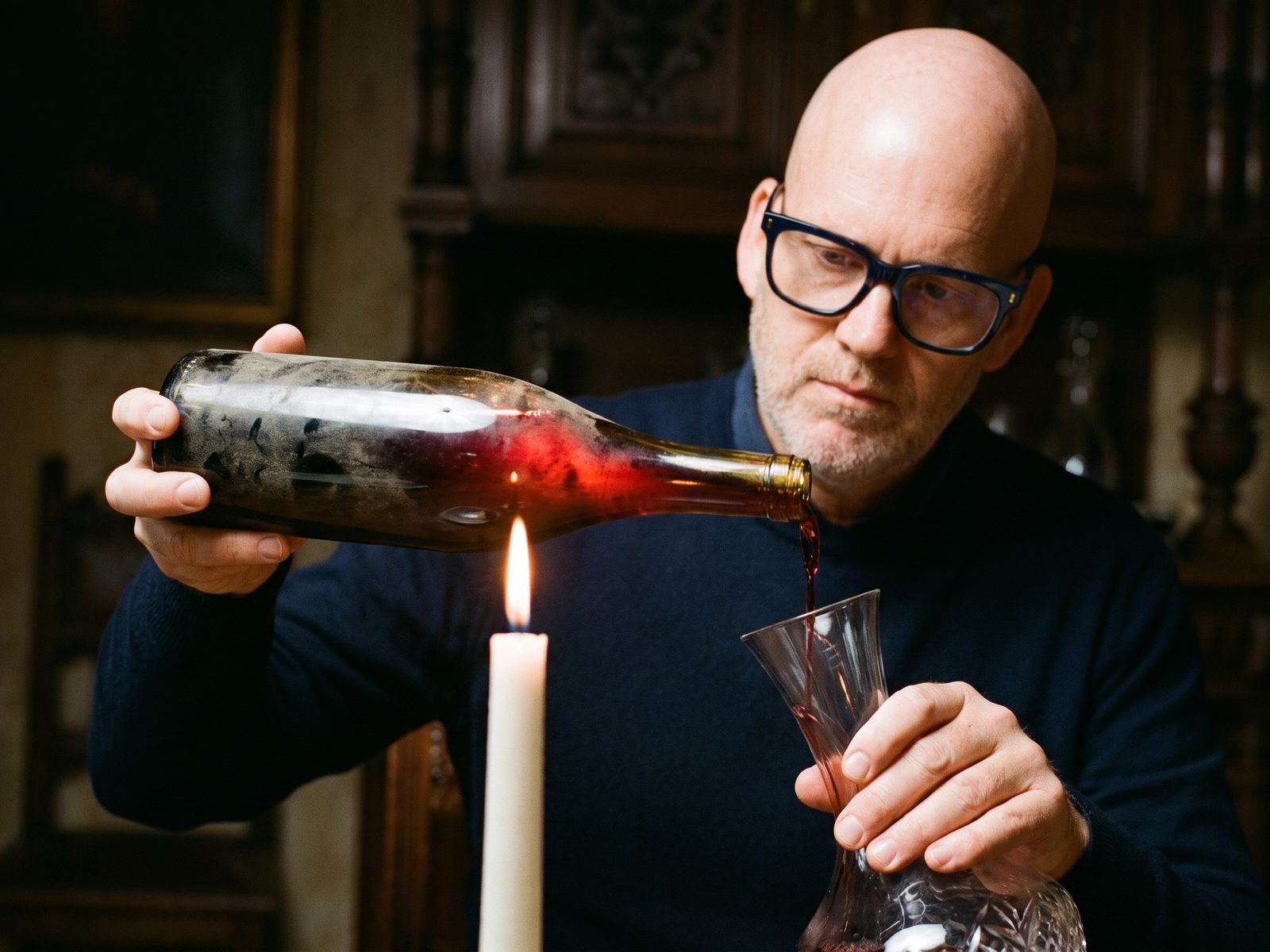
The light is the whole trick. Shining up through the shoulder and neck as you pour, it lets you see the clear wine running and the first dark threads of sediment arriving, so you can stop at exactly the right moment and leave only a few centimetres of murky wine in the bottle.
What you need
- Narrow decanter: A small upright decanter or carafe; less surface, less air.
- Torch or candle: Light shining up through the shoulder and neck as you pour.
- Durand or Ah-So: For the old, fragile cork.
- Decanting funnel with strainer (optional): Catches the last of the sediment and any cork crumbs.
- Decanting basket (optional): For a bottle you could not stand upright in time.
- Decanting cradle (optional): Tips the bottle a fraction at a time for a perfectly smooth pour.
- Decanter cleaning beads and drying stand (optional): Clean the decanter without scratching it.
Step by step
- Stand old bottles upright For any bottle you expect to have sediment, stand it upright for at least 24 hours before serving, so the deposit slides down the side and settles in the base. Old bottles stored on their side have a stripe of sediment along the lower flank, and it needs time to fall. Vintage port and very old wines are better with two or three days. Tip: If you have to bring the bottle from a cellar the same day, carry it gently on its side in the same position it lay in, and decant from that angle. A decanting cradle or bread basket keeps it steady.
- Open without disturbing Cut the capsule below the lip and wipe the top of the bottle clean. Draw the cork slowly and smoothly, without jerking or tipping the bottle. Old corks can be soft; if one starts to crumble, an Ah-So puller that grips the sides often brings it out in one piece. Tip: If a corner of cork breaks off into the wine, leave it. It floats and will stay behind if you pour slowly, or you can fish it out with a clean teaspoon.
- Set up your light Place a candle or torch so the light shines up through the shoulder and neck of the bottle as you pour. You want to be able to see the wine running clear through the neck and to spot the moment the sediment arrives.
- Choose a narrow decanter Use a small, upright decanter or carafe rather than a wide ship's decanter. Less surface means less air, which is what an old wine needs. A clean glass jug works too.
- Pour in one slow, steady movement Tilt the bottle gradually and pour down the inside wall of the decanter, keeping the flow continuous. Stopping and righting the bottle sends the wine slopping back over the sediment and stirs it up. Watch the neck against the light the whole time. Tip: For a sediment pour, keep the bottle mouth close to the decanter so the wine slides in quietly. For a young wine that needs air, the opposite: pour from higher up straight into the centre and let it splash.
- Stop when the sediment reaches the neck As the bottle empties you will see dark threads or a cloudy plume creep up towards the neck. Stop pouring there. You will usually leave behind 20–50 ml of murky wine, more with port. That is the price of a clean decanter. Tip: The last cloudy splash can go into a sauce or a braise once it has settled again in a glass, so it is not wasted.
- Serve soon, taste every 15 minutes Pour a small glass straight away. An old wine is often at its best in the first 30 to 60 minutes, then starts to fade. Taste again every quarter of an hour and serve it while it is singing, rather than leaving it in the decanter all evening. Tip: Keep the last murky centimetres in the bottle for a sauce; strained, they still taste of the wine.
- No time to stand it up? Use a basket Bring the bottle from the cellar lying in a decanting basket, at the angle it was stored, so the sediment stays along the side. Open it in the basket and pour in one steady movement without tipping it back.
Old Barolo and Barbaresco
An old Barolo from a good vintage, 25 or 30 years on, is the opposite job. Stand it upright for a couple of days, decant it over a candle just before you sit down, and drink it over the next hour. The aromas of dried roses, leather and truffle that make old Nebbiolo so prized are fragile, and they can fade if you leave the wine sitting in a wide decanter all afternoon.
Old Barbera, with its high acidity, usually holds up well once decanted. Old Moscato and Dolcetto rarely need it, and rarely improve. Browse aged Nebbiolo on the wines page.
Decanting cradles and baskets
A decanting cradle holds the bottle on a screw-driven arm and tips it a fraction at a time, so the pour stays perfectly smooth. It is a sommelier tool, useful when you open old bottles often. A simple wicker or wire basket does a similar job for a bottle brought straight from the cellar: leave it lying in the basket, open it there and pour in one steady movement.
Young wine or old?
A young, tight wine needs the opposite treatment: a wide decanter, a vigorous pour and a few hours of air. That is in Decanting young wine, and the quicker tools are compared in Aerating wine.
If something goes wrong
The wine tastes flat and tired after decanting
It had too much air for its age, or it warmed up too much. Old wines can fade within an hour, so decant them just before serving. Pour what is left back into the bottle and cork it, and chill the decanter briefly if the wine has gone above 18 °C.
Sediment got into the decanter
You poured too fast, stopped and started, or the bottle had not stood long enough. Leave the decanter still for 30 minutes so the sediment falls, then pour gently into a clean jug or the rinsed bottle. For heavy port crust, pour through a fine muslin or an unbleached coffee filter rinsed first with hot water, so it gives no papery taste.
The wine smells of damp cardboard
That is cork taint, caused by a compound called TCA. Air does not remove it and often makes it more obvious. Return the bottle to the shop if you can.
The decanter looks cloudy or stained
Red wine stains and hard-water marks are the usual cause. Swirl warm water with cleaning beads, or coarse salt with a splash of white vinegar, then rinse thoroughly with hot water. A milky film that will not shift after the dishwasher is etching in the glass, and it is permanent.