Aerating wine: methods and tools
From swirling the glass to aerating pourers, hand-held aerators, shower funnels, electric aerators and even the blender: what each way of giving wine air really does, and when it is worth it.
Why it works
Aerating is giving a wine air quickly, so that the heavy, closed smells of a young bottle blow off and the fruit comes forward. Every method does the same thing in a different way: it spreads the wine thin, splashes it, or forces air through it, so more of the wine touches oxygen for a moment.
The difference between methods is mainly how much air, and how fast. A swirl in the glass gives a little, again and again. A pourer or a hand-held aerator gives a burst as you pour. A wide decanter gives a lot, slowly, over hours. A blender gives a violent amount in seconds. More is not always better: a delicate or old wine can lose its aromas as easily as a young one gains.
Most of the effect is on aroma and on dissolved carbon dioxide, not on the tannin itself. That is why quick aerators help most with young, reductive reds such as a young Barolo, Roero or Barbera Superiore, and least with wines that are already open.
What you need
- Hand-held aerator: Pulls air into the wine as you pour through it into the glass.
- Aerating pourer (optional): A spout for the bottle that aerates every pour.
- Aerating funnel (optional): Showers the wine into a decanter.
- Electric aerator (optional): A battery pump that pours aerated wine at the press of a button.
- Wide ship's decanter (optional): The most air, over time.
- All-purpose wine glasses: The simplest aerator: a glass with room to swirl.
- Blender (optional): For hyper-decanting a very tight young red; a last resort.
Step by step
- Swirl the glass Pour a third of a glass and swirl it on the table in small circles for a few seconds, then smell. Repeat between sips. This is the simplest aerator of all, and for many wines all you need.
- Give the glass ten minutes Pour a glass and leave it while you open the rest. Comparing the first sniff with one ten minutes later tells you whether the bottle needs more air at all.
- Aerating pourer: for the bottle on the table A spout with a small air channel that pushes into the neck. As you pour, it draws air into the stream. It gives a modest lift to every glass and works as a drip-free pourer too.
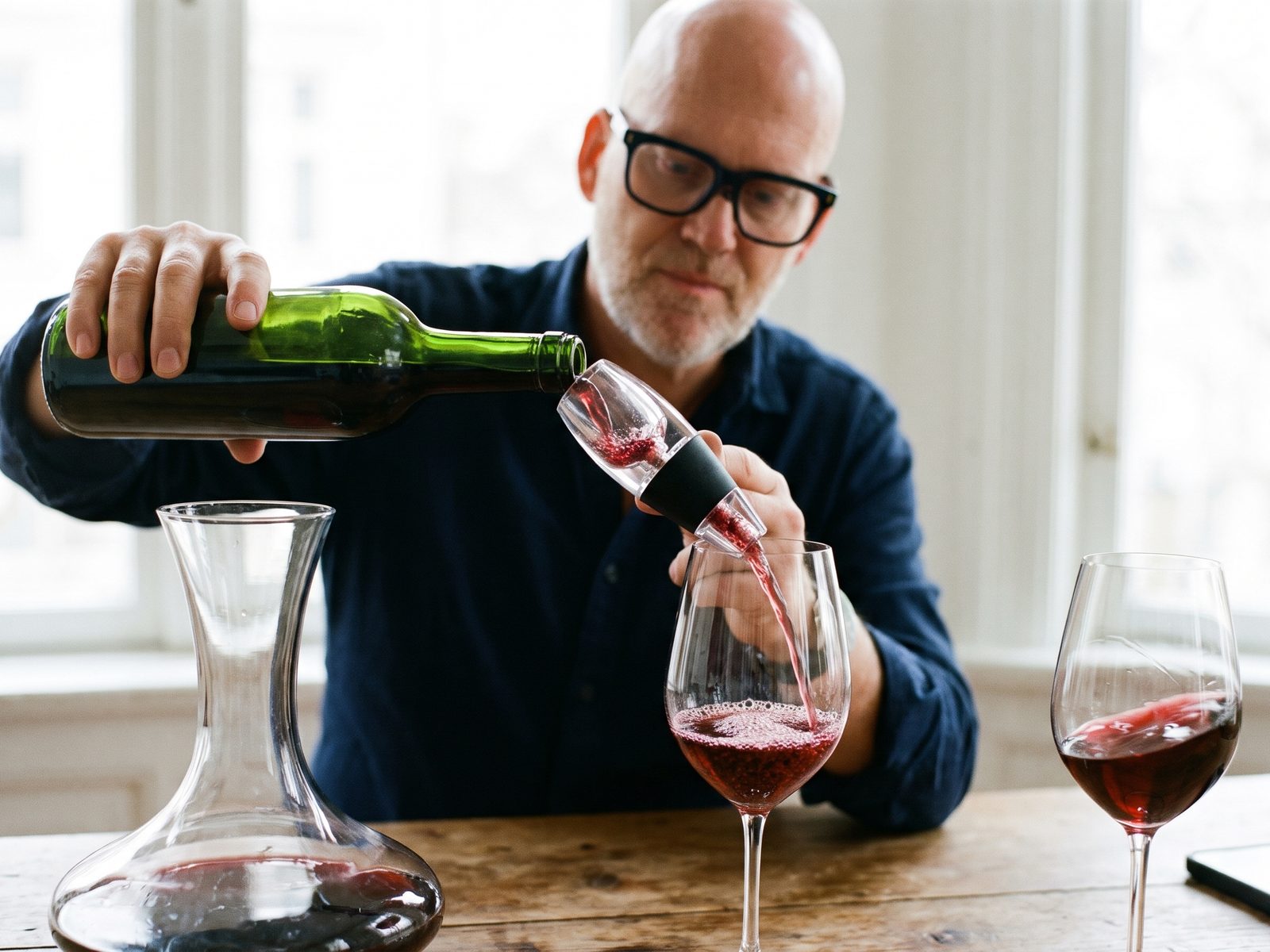
- Hand-held aerator: a quick burst per glass Hold the aerator over the glass and pour the wine through it. Side holes pull air into the stream as it rushes through, with a hiss. It is the fastest way to open a single glass of a young red. Tip: Pour at a steady speed: too slow and it barely aerates, too fast and it splashes.
- Aerating funnel: more air into the decanter A funnel with a perforated spreader that showers the wine onto the sides of the decanter. Use it with any decanter to give a young wine a head start.
- Electric aerator: at the press of a button A battery pump sits on the bottle, draws the wine up a tube and pours it aerated. Convenient for a bottle that stays on the table, though it adds no more air than a good hand-held aerator.
- Wide decanter: the most air, over time For a big young wine, nothing beats a brisk pour into a wide decanter and an hour or more of rest. See Decanting young wine.
- Blender: the last resort A few seconds in a blender, known as hyper-decanting, opens a very tight young red at once. It foams, needs a few minutes to settle, and is rough on aroma. Never use it for an old or fine wine.
What not to aerate
Old wines, which lose their delicate bouquet; sparkling wines, which lose their bubbles; light, fragrant reds such as Grignolino and young Dolcetto; and most whites, Arneis and Moscato included. These are best poured straight into a good glass.
Do aerators really work?
A little, and mostly on young, reductive reds. In side-by-side tastings the effect of a hand-held aerator is noticeable but smaller than an hour in a decanter. Think of aerators as a convenience for a glass now, and the decanter as the real tool when you have time.
If something goes wrong
The wine tastes harsher after the aerator
Some wines, especially lighter or older ones, lose their fruit with a sudden burst of air and the alcohol and tannin stand out. Use gentler swirling in the glass for these, and keep aerators for young, closed reds.
The aerator drips and splashes
Pour at a steady, medium speed and hold the aerator just above the rim of the glass. Rinse it with water after each use so wine does not dry in the air holes.
The blended wine is all foam
Let it settle for five to ten minutes before pouring. Next time blend for a few seconds only, on the lowest speed.