Opening a bottle of still wine
The right corkscrew, a calm hand and a few small habits get any bottle open cleanly, from a screwcap Arneis to a firm Barolo cork.
Why it works
A natural cork is bark from the cork oak, a honeycomb of tiny air-filled cells. Squeezed into the neck, it pushes back against the glass, and that grip is what keeps the wine in for years. It is also what you are fighting when you open the bottle. Pull straight up with arm strength and the friction resists you; use a lever and the same job takes a fraction of the effort.
That is why the two-step waiter's friend is the tool most sommeliers carry. The worm, the spiral, bites into the cork. The hinged arm rests on the lip of the bottle and turns your pull into leverage. The first step lifts the cork halfway, the second takes it almost all the way, and the last few millimetres come out by hand so the cork never pops. A good worm is an open spiral with a sharp tip, like a pig's tail. It grips the cork without tearing a channel through it.
Old corks are a different problem. After twenty or thirty years the cork dries, softens and may stick to the glass, so a worm can tear through it or push it down. The Ah-So, two thin prongs that slide down between cork and glass, grips the cork from the outside and lifts it whole.
What you need
- Waiter's friend: A two-step lever corkscrew with a small foil knife; the one tool to own if you only own one.
- Clean cloth or napkin: For wiping the lip, holding a sparkling cork, and catching drips.
- Ah-So (two-prong puller) (optional): Lifts old, fragile corks from the outside without piercing them.
- Coffee filter or fine tea strainer (optional): Catches crumbs of cork if a cork breaks up.
- Decanter or clean jug (optional): Somewhere to strain an old wine or a bottle with cork in it.
Step by step
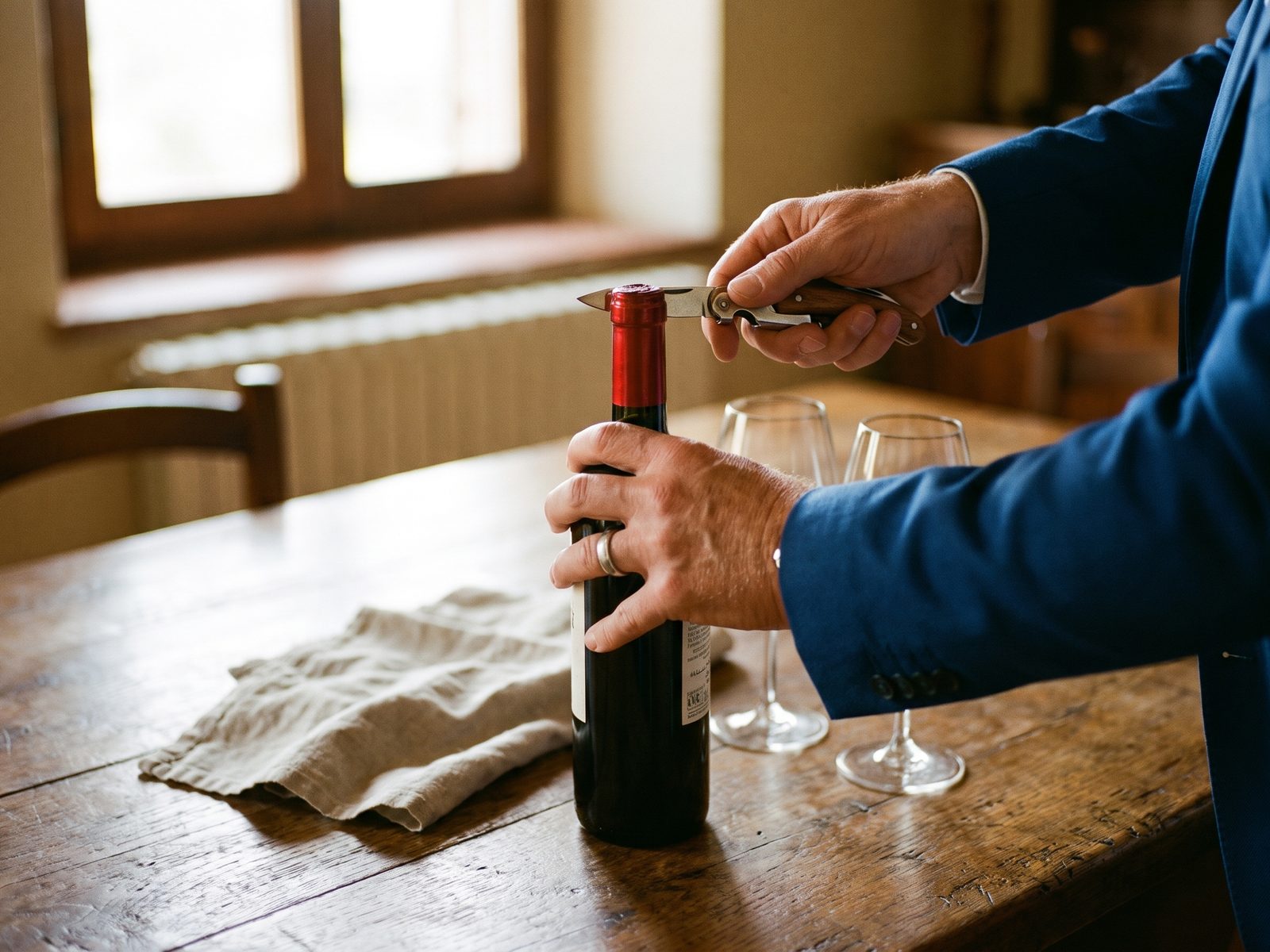
- Cut the foil below the lip Run the little knife round the neck just under the raised lip, the second ring of glass below the top. Turn the bottle, not the knife, then make one short vertical cut and peel the top away. Cutting below the lip means the wine never runs over the foil as you pour, which can taste metallic and drips.
- Wipe the top Wipe the top of the cork and the lip with a cloth. Old bottles often have a little mould or dried wine under the foil. It is harmless and does not mean the wine is bad, but you do not want it going in the glass.
- Centre the worm and screw in Set the point slightly off-centre and tilt it so the spiral, not the point, ends up running down the middle of the cork. Straighten up and turn the corkscrew, not the bottle, keeping it vertical. Stop when one turn of the spiral is still showing above the cork. That last turn keeps the tip from punching out of the bottom of the cork and dropping crumbs into the wine. Tip: If the worm goes in crooked, back it out and start again. A crooked worm tears the cork on the way up.
- Lever with the first step Fold the arm down and hook the first notch on the lip of the bottle. Hold the notch in place with your thumb and lift the handle slowly. The cork rises about halfway.
- Switch to the second step Move to the second notch and lift again. Lift straight up in line with the neck rather than pulling sideways, which can bend the cork and snap it.
- Ease out the last bit by hand When only a centimetre is left, hold the cork in your fingers and wiggle it out gently. It should leave with a soft sigh. Unscrew the cork from the worm.
- Check the cork, briefly Look at it: wine should have stained only the bottom few millimetres, and the cork should be springy. A cork soaked through its length or shrunken can mean the wine has had air. Smell the bottom only to catch an obvious musty, wet-cardboard note, a sign of cork taint. Then smell the wine itself, which is what really tells you.
- Screwcaps: twist the base Hold the long sleeve of the cap in one hand and the bottle in the other. Twist the bottle, or the lower sleeve, until the perforation cracks, then unscrew the top. Tip: Screwcaps are not a sign of cheap wine. Many fine whites, and plenty of reds, use them because they seal consistently and cannot be corked.
- Synthetic corks Open them exactly like natural corks. They grip harder, so a waiter's friend helps, and they can be tight to remove from the worm. They do not crumble, but they are not designed for long ageing, so drink those wines young.
- Pour from the side Hold the bottle by the body with the label facing your guest, and pour from their right. Fill a still wine glass about a third full, which leaves room to swirl and smell. As you finish, lift the neck and give the bottle a quarter turn so the last drop stays on the rim of the bottle, not the tablecloth. Tip: Pour yourself a small taste first. If the wine is corked, you will find out before anyone else does.
Opening sparkling wine
Sparkling wine is opened by hand, not with a corkscrew, and the cork is under pressure. The method is in Opening sparkling wine, and the sabre in Sabrage.
Opening very old bottles
Old corks are soft, dry and often stuck to the glass, and a normal corkscrew can tear straight through them. Stand the bottle upright for a day or two, remove all the foil and use an Ah-So or a Durand, which lift the cork from the outside.
The full method, including what to do when a cork breaks and how port tongs work, is in Opening old bottles.
Saving an opened bottle
Push the cork back in, clean end down, and keep the bottle upright in the fridge, red wine included. Most still wines keep for 2 to 4 days this way; sparkling wine needs a clamp stopper.
Half bottles, argon, vacuum pumps and the Coravin are compared in Keeping an open bottle.
If something goes wrong
The cork broke in half
Usually the worm went in off-centre or not deep enough, or you pulled sideways. Screw the worm back into the remaining piece at an angle, gently, so it bites into the side with most cork, and lever it out slowly. If it is very soft, use an Ah-So on what is left.
I pushed the cork into the bottle
The wine is fine. Pour it slowly while holding the cork back with a chopstick or skewer, or decant it.
There are bits of cork in the wine
Cork crumbs are tasteless and harmless, just unpleasant in the mouth. Pour the wine through a coffee filter or a fine tea strainer into a decanter.
The wine smells of wet cardboard or a damp cellar
That is cork taint, caused by a compound called TCA. It is not harmful but it flattens the fruit and does not go away with air. Put the cork back in and return the bottle to the shop; most good merchants will replace it.