Ferrando's Carema Etichetta Nera: Mountain Nebbiolo on Stone Pillars
A rare black-label Carema from 2.5 hectares of terraced pergolas at the foot of the Alps, made only in the best vintages.
Il Vino Bello ·
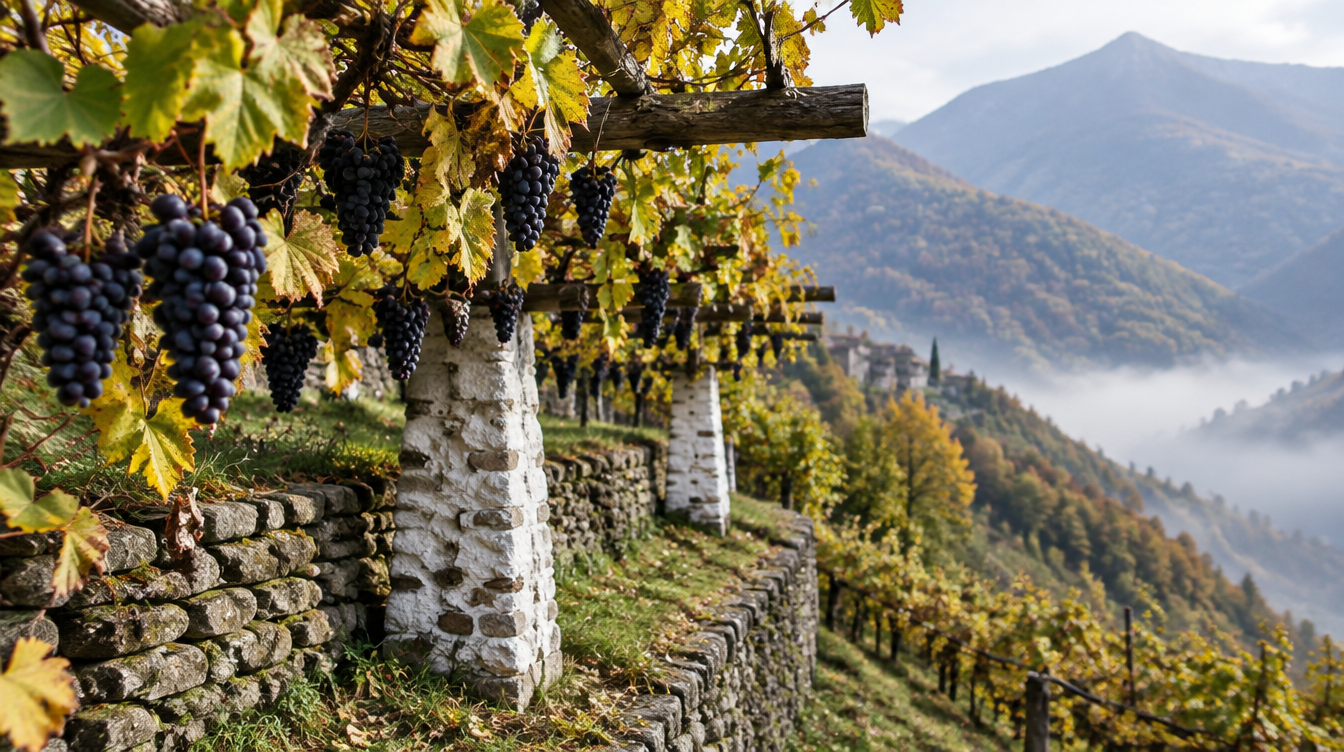
In Carema, the last Piemonte village before the Aosta Valley, Nebbiolo grows on stone pergolas above the Dora Baltea. Ferrando's technical sheets give the harvest as after 15 October, and the best of those grapes become Etichetta Nera, a black-label Carema the family makes only in the years it judges good enough.
A tiny denomination at the foot of the Alps
Carema is one of Piemonte's smallest wine zones. Ferrando counts only 16 hectares of Nebbiolo vineyards in the commune; Decanter, writing in 2022, put the figure at about 18 and called it the smallest growing appellation in Italy. Either way, it is a long way down from the more than 120 hectares the same Decanter piece reports for the early 1900s, before growers left the vineyards after the Second World War for jobs that were more profitable and less tiring.
The rules are simple and strict. The grapes must come from the commune of Carema itself, from rocky slopes of moraine soil between 300 and 600 metres, with valley-floor sites excluded. Nebbiolo makes up at least 85 per cent of the wine, and in practice most producers use it alone, in the local form called Picotener or Picotendro. Carema became a DOC in 1967, one of the first in Piemonte. The original rules asked for three years of ageing, two of them in wood; the current version, as summarised by Decanter, requires 24 months with 12 in wood, and 36 months for the Riserva.
Pergolas, pillars and hand work
What sets Carema apart is the vineyard itself. The vines are trained on low pergolas called topie, held up by tapering stone and lime pillars known as pilun, on terraces shored up by dry stone walls. Ferrando's own description of the pillars is practical: together with the walls, they store the sun's heat during the day and release it in the chilly nights. The estate also notes the soils' acidic character, with a pH between 5 and 6.
Almost nothing here can be mechanised. Speaking at this year's Carema Prima, the preview of the new Carema vintages held on 21 September, grower Vittorio Garda of Sorpasso described parcels reached by steps, low walls and narrow spaces, so that even a few rows take far longer to work than vines on gentler hills, according to Tasting Life (8 October). The same evening, Achille Milanesio of Cantina Togliana talked about fifty harvests and a changing climate: warmer seasons and earlier picking, with the Canavese consorzio reporting particularly early ripening in Caluso, Canavese and Carema this summer (Tasting Life, 9 October).
The Ferrando story
Ferrando began as a wine merchant. Giuseppe Ferrando moved from Acqui to Ivrea in 1890 to sell Piemonte wines in the neighbouring Aosta Valley. In 1957 his grandson, also Giuseppe, started making Carema, and in 1964 the family built a cellar in Carema to make and age it. Luigi Ferrando took over in the early 1980s, and his son Roberto runs the company today.
The estate farms 2.5 hectares in Carema, picked by hand. It makes two Carema wines from them. Etichetta Bianca, about 7,000 bottles, is fermented in steel with roughly ten days on the skins and aged 36 months, 30 of them in oak. Etichetta Nera comes from a further selection of the grapes, made in steel the same way, with about 3,000 bottles in the years it is produced. The estate's product page gives at least three years in its cellars, at least two of them in barrique; its page on the territory speaks of 36 months in barrique and tonneau. Either way, the wine spends longer in wood than today's rules require, and in small barrels.
How the estate describes the wine
Ferrando describes Etichetta Nera as intense garnet, clear and dense, with spice and ripe red berries on the nose and finer notes of violet, wild berries and vanilla. On the palate it speaks of alcoholic warmth, developing tannins and a firm, well-balanced structure, and says the wine is at its best a few years after bottling. Its suggested service is 18 to 20 °C in large red-wine glasses, with red meat, braised dishes, game and mature cheeses.
If you want a lighter comparison, the white-label Carema is described in more delicate terms, with dried flowers and rose petals. The DOC rules themselves describe Carema's aroma as recalling macerated rose.
Other Carema wines on the site
Etichetta Nera is rare, so it helps to know the neighbours. The village cooperative, Cantina dei Produttori Nebbiolo di Carema, makes a Carema aged two years with at least 12 months in large oak. Santa Clelia ages its Carema three years in wooden casks. At the newer end, Sopravvento makes its Carema from terraces it recovered from abandonment in 2019; the first vintage, 2022, ran to 567 bottles.
Ferrando does not advertise visits or tastings, so write or call ahead if you are passing through Ivrea. With only a few thousand bottles in the years it is made, Etichetta Nera is a wine to look for on Piemonte wine lists and in specialist shops rather than to expect.
Sources
- http://www.ferrandovini.it/eng/carema-en.html
- http://www.ferrandovini.it/carema-en.html
- http://www.ferrandovini.it/eng/carema-eb.html
- http://www.ferrandovini.it/territorio.html
- http://www.ferrandovini.it/eng/about.html
- https://www.tastinglife.it/2026/10/08/carema-prima-2026-vittorio-garda-racconta-sorpasso-tra-nebbiolo-terrazzamenti-e-viticoltura-di-montagna-21-settembre-2026/ (8 Oct 2026)
- https://www.tastinglife.it/2026/10/09/carema-prima-2026-achille-milanesio-di-cantina-togliana-racconta-cinquantanni-di-vendemmie-tra-i-vigneti-del-picotendro/ (9 Oct 2026)
- https://www.decanter.com/learn/what-is-carema-ask-decanter-475667/ (22 Mar 2022, background)
- https://www.regione.piemonte.it/governo/bollettino/abbonati/2009/20/attach/comunicato_agricoltura_0403.pdf (Carema DOC rules, 1967 text and revision)