Amphora Wines in Piemonte: Terracotta, Ceramic and What They Change
From skin-contact Gavi to Barbaresco finished in ceramic, why more Piemonte cellars now keep clay jars beside their oak casks.
Il Vino Bello ·
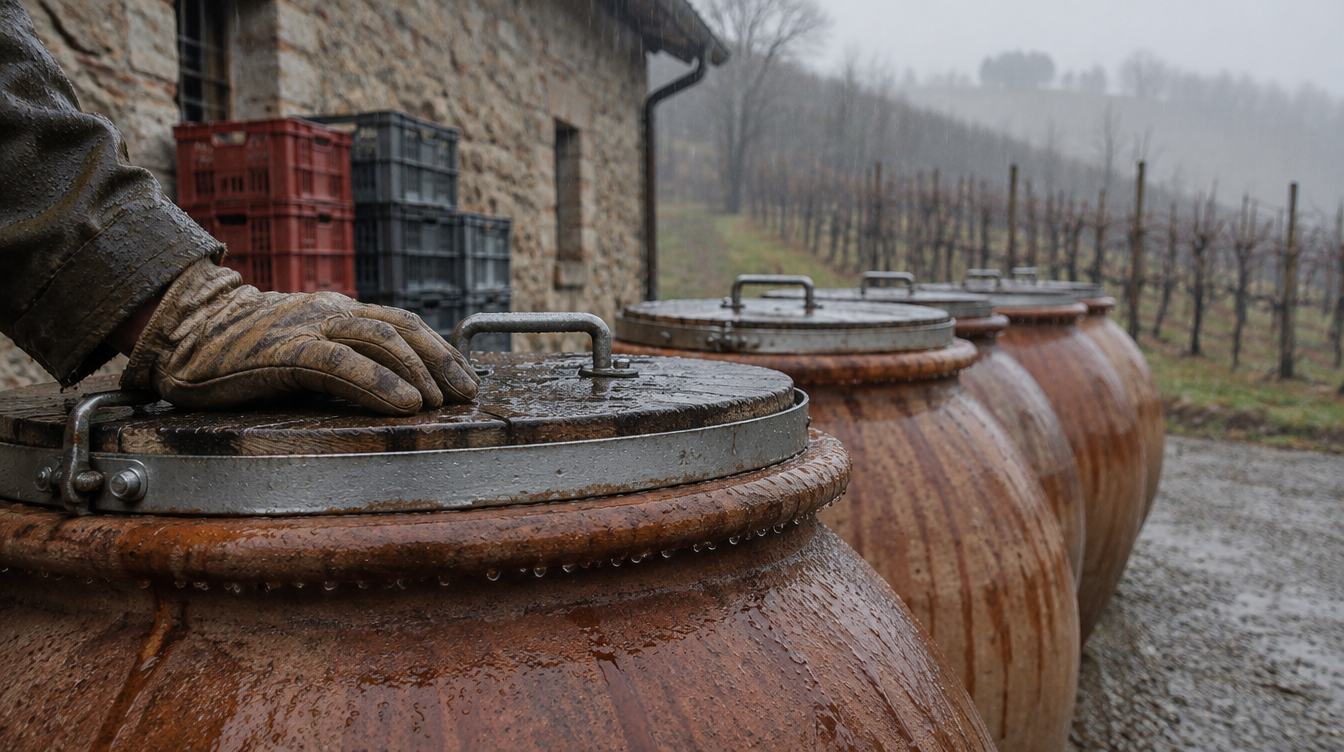
Walk into a Piemonte cellar this winter and, next to the oak casks and steel tanks, you may find a row of clay jars. On 1 November L'Espresso described how Paolo Manzone in Serralunga d'Alba uses a Tuscan ceramic amphora for his Barolo Riserva, and you can now find terracotta, ceramic and stoneware jars from Gavi to Barbaresco. Here is what they are, what they do, and which bottles on our site show it.
Terracotta, ceramic and stoneware are not the same jar
"Amphora" on a label or tech sheet covers several materials, and they behave differently. In a December 2025 feature, the trade paper Il Corriere Vinicolo explained that a clay vessel's porosity depends on the clay mix and the firing temperature: the lower the firing, the more oxygen the wine exchanges with the outside. Terracotta can allow micro-oxygenation equal to or greater than a wooden cask, it says, while ceramic and stoneware (gres) bring that exchange close to zero.
The same piece describes clay, like steel, as almost neutral: it does not give aromas to the wine, with one exception, long macerations and ageing in young terracotta, where it notes subtle earthy shades. Like concrete, clay also has thermal inertia, so the wine inside is protected from swings in temperature. It names the vessels Italian producers are buying: terracotta from Impruneta in Tuscany, Tuscan cocciopesto, and newer "technical clays" such as Tava and Clayver.
Mura Mura, in Costigliole d'Asti, puts the difference in its own words: ceramic is terracotta with added minerals, mainly quartz and feldspar, which allow higher firing temperatures and a slower exchange with the air.
Skin-contact whites in terracotta
The clearest use of terracotta in Piemonte is for whites fermented on their skins. At La Zerba in the Gavi zone, destemmed Cortese for the Anfora ferments spontaneously in terracotta, with 30 to 40 days on the skins. The estate then leaves the amphorae outdoors over winter so the cold settles the tartrates naturally, and the wine stays about nine months on its fine lees, without fining or filtration. The first vintage was 2017.
Nearby, Fontanassa makes its Gavi Due Padri in terracotta amphorae made by the Impruneta potter Massimo Carbone, first produced in 2018. Castello di Tassarolo ferments Cortese with lightly pressed grapes in round handmade amphorae for its Orange, then lets the grapes rest in the amphorae for about eight months, according to our curated notes. In the Colli Tortonesi, Claudio Mariotto gives his Timorasso L'Imbevibile about 15 days of skin contact, then 12 months on the lees in amphora.
Nebbiolo and the local reds
Reds go into clay for fermentation as well as ageing. La Biòca puts its Nebbiolo d'Alba La Pipina straight into the amphora, 30 percent as whole bunches and 70 percent destemmed. The estate's tech sheet gives 15 to 20 days of fermentation, malolactic in the same amphora and 11 months of ageing there, for 2,000 to 2,500 bottles a year.
Other estates use clay instead of oak for a familiar grape, according to the notes on our wine pages. Francone ages its Langhe Nebbiolo Anfora for ten months in 320 and 500 litre stoneware amphorae and bottles it unfiltered. Montalbera gives its Grignolino d'Asti Lanfora eight to ten months in Impruneta terracotta of different sizes.
A second year in ceramic for Barolo and Barbaresco
A third approach pairs the two: oak first, then ceramic. Mura Mura says it chose ceramic from the start for the second year of ageing, when a clearer wine needs gentler oxygen, and gives a figure of 10 mg of oxygen per litre per year. Its cellar opened in 2019, and its Barbaresco Serragrilli, from a quarter of a hectare in Neive, spends 12 months in 25 hectolitre French oak and then 12 months in 400 litre ceramic amphorae.
Ca' Viola ages its Sottocastello di Novello Riserva about 36 months in large casks and 12 months in ceramic amphorae, for around 1,800 bottles. Paolo Manzone does something similar with his Barolo Riserva: three years in wood, then one to two years in 500 litre Tuscan ceramic amphorae, 60 months in all.
How to find them
The vessel rarely appears on the front label, so the producer's tech sheet is the place to look. On our wine pages it is usually in the vinification notes. Some names give it away, like Anfora and Lanfora; for the Barolo and Barbaresco above you would never know from the label.
If you want to go further, the Italian writer Ivano Asperti's book "Anfora, la misura del vino" (Cinquesensi, 432 pages, 35 euro) was announced for February 2026, built on his visits to seven makers of amphorae and fifty winemakers. And if you visit the hills, Mura Mura offers cellar visits with tastings of its crus by booking, which is a good chance to see the ceramic vessels next to the oak.
Sources
- https://www.cinquesensi.it/wp-content/uploads/2025/11/CorriereVinicoloN40.pdf (Il Corriere Vinicolo n. 40, 22 December 2025)
- https://lespresso.it/c/cantine/2026/11/01/tra-le-vigne-storiche-di-serralunga-paolo-manzone-coltiva-unidea-di-vino-che-non-rincorre-le-mode/65649 (1 November 2026)
- https://www.muramura.it/winery
- https://www.muramura.it/wine/rigore/serragrilli
- https://www.la-zerba.it/it/vini/
- https://www.fontanassa.com/prodotto/due-padri/
- https://www.labioca.it/vini/la-pipina-2022/